
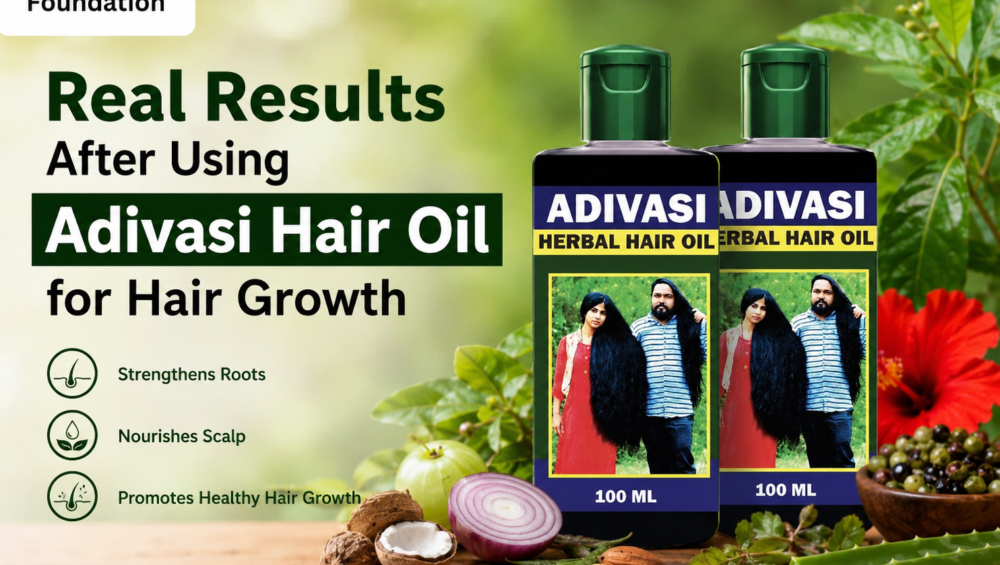
Hair growth is rarely an overnight transformation. For most people, meaningful changes come from consistent scalp care, reduced breakage, suitable nutrition, and patience. This is why people who try Adivasi Hair Oil for Hair Growth often want to know one thing before making it part of their routine: What kind of results can I realistically expect?
Adivasi Foundation promotes a traditional herbal approach to hair care, with an emphasis on nourishing the scalp and maintaining stronger, healthier-looking hair. The company’s own product information describes Adivasi Hair Oil as a formulation intended to support scalp nourishment, hair strength, moisture, texture, and reduced breakage.
However, real hair-care results should be discussed honestly. Hair oil can condition the scalp and hair shaft and may help minimize dryness and breakage, but that is different from medically treating every cause of hair loss. Scientific literature on hair oiling remains limited, with stronger evidence for some specific oils and benefits related to hair-shaft protection rather than a universal increase in hair growth.
What Real Results Can Look Like
When someone begins using an herbal hair oil, the first noticeable change may not be new hair growth. It may be softer hair, less dryness, improved manageability, or a scalp that feels more nourished.
These improvements matter because hair appearance depends on more than the number of follicles producing new strands. Dry or fragile hair can break before reaching its potential length. Conditioning the hair shaft can therefore help preserve existing length and make the hair appear fuller and healthier.
With Adivasi Hair Oil for Hair Growth, a sensible expectation is to look for gradual improvements rather than dramatic changes within a few applications.
Potentially noticeable changes include:
- Hair feeling softer and better conditioned
- Reduced dryness in the scalp or hair lengths
- Less breakage caused by dryness and friction
- Improved hair texture and manageability
- A healthier-looking scalp
- Hair appearing fuller because fewer strands are breaking
- Better consistency in an overall hair-care routine
These outcomes should not automatically be interpreted as proof that dormant follicles have been regenerated. Hair loss can have many causes, including genetics, hormonal changes, nutritional deficiencies, stress, illness, inflammation, and scalp disorders. An oil cannot be expected to address all of these causes.
Why Consistency Matters More Than Quick Results
One of the biggest mistakes people make with hair products is changing their routine too frequently. Hair grows through different biological phases, so visible changes naturally take time.
A person may use an oil for several applications and notice better softness or shine fairly quickly. Changes related to hair density or length require a much longer observation period.
Adivasi Foundation recommends regular use of its hair oil as part of a consistent hair-care routine, with its published material suggesting application two to three times per week for many users.
The precise frequency, however, should depend on the individual. Someone with a dry scalp and coarse hair may prefer a different routine from someone with a naturally oily scalp or fine hair.
Consistency also means applying the product correctly. Using excessive quantities does not necessarily produce better results. A moderate amount distributed across the scalp is generally more practical than saturating the hair with oil.
The Role of Scalp Massage
The application process itself may contribute to the overall hair-care experience.
Gentle fingertip massage helps distribute oil across the scalp while providing a relaxing part of the routine. Research has also explored whether mechanical stimulation from scalp massage can influence hair characteristics.
A small study involving nine healthy men found that standardized scalp massage over 24 weeks was associated with an increase in hair thickness, although the study did not find a significant improvement in hair growth rate. Because the study was small, its findings should not be treated as proof that massage or any particular hair oil will produce the same outcome for everyone.
For this reason, when using Adivasi Hair Oil for Hair Growth, gentle massage is better viewed as a supportive hair-care practice rather than a guaranteed hair-regrowth treatment.
Use the fingertips rather than scratching with the nails. Excessive pressure can irritate the scalp, particularly when the skin is already sensitive.
What Users May Notice During the First Few Weeks
Early results are often related to hair condition rather than density.
After incorporating an oil into a routine, some users may notice:
A softer feel:
The hair may feel smoother because oil helps reduce dryness and friction.
Improved manageability:
Hair that previously felt rough or difficult to comb may become easier to handle.
Less visible dryness:
A properly selected oil can help support moisture retention and improve the appearance of dry hair.
Better shine:
The coating provided by oil can make strands appear smoother and shinier.
Reduced breakage:
When dry hair becomes better conditioned and is handled more gently, breakage may decrease.
These changes can make hair appear healthier even when the number of follicles has not changed.
That distinction is particularly important when evaluating claims about hair growth. A thicker-looking ponytail or longer hair may result partly from reduced breakage and improved hair retention rather than a sudden increase in the rate at which follicles produce hair.
What May Happen After Longer-Term Use
Longer-term results are more difficult to predict because every person’s hair cycle, genetics, lifestyle, scalp condition, and underlying causes of shedding are different.
Someone whose main concern is dryness and breakage may see a meaningful improvement in overall hair appearance. Someone experiencing genetic hair loss may require a completely different treatment strategy.
A useful way to evaluate Adivasi Hair Oil for Hair Growth is to track several factors rather than relying on one mirror check.
Consider monitoring:
- Amount of hair noticed during washing
- Hair breakage while combing
- Scalp dryness or discomfort
- Hair texture
- Hair length retention
- Overall appearance and manageability
- Changes in visible thinning
Taking photographs under similar lighting every four to six weeks can provide a more objective comparison than relying on memory.
The same hairstyle, camera position, lighting, and hair condition should be used whenever possible.
Adivasi Hair Oil and Hair Fall: What to Expect
Hair fall and hair breakage are not the same thing.
Hair shedding occurs when strands naturally leave the growth cycle. Breakage occurs when a hair shaft snaps before completing its natural length.
An oil can be useful for conditioning the hair shaft and supporting better hair-care practices, but persistent shedding may have an underlying cause that needs attention.
Medical sources note that hair oils generally provide conditioning and scalp-care benefits rather than acting as standalone treatments for significant hair loss.
This distinction makes realistic expectations particularly important.
If a person has noticed more hair on a pillow or comb, it does not necessarily mean an oil has failed. Likewise, seeing smoother hair after oiling does not prove that new follicles have developed.
The most useful question is: What is causing the hair concern in the first place?
How to Use Adivasi Hair Oil More Effectively
The quality of a hair-care routine depends partly on application habits.
Start with a manageable quantity of oil. Apply it to the scalp and distribute it gently with the fingertips. A light massage can help spread the product evenly without pulling the roots.
For people who prefer pre-wash oiling, leaving the oil on for a few hours before cleansing can be practical. Adivasi Foundation’s published recommendations mention two to four hours as a suitable period for many users, while noting that overnight application is another option when comfortable.
The scalp should then be cleansed appropriately. Leaving large quantities of oil on the scalp for excessive periods does not guarantee better results and can contribute to buildup or irritation in some individuals.
A simple routine may look like this:
Step 1: Section the hair if necessary.
Step 2: Apply a moderate amount of Adivasi Hair Oil to the scalp.
Step 3: Massage gently with the fingertips.
Step 4: Distribute a small amount through dry lengths if needed.
Step 5: Leave it for a suitable period.
Step 6: Wash thoroughly using an appropriate cleanser.
Step 7: Repeat consistently according to your scalp and hair needs.
Realistic Expectations Versus Marketing Claims
The hair-care industry contains many impressive promises. Claims of extremely rapid hair growth can be tempting, particularly for people experiencing thinning or excessive shedding.
Professional evaluation requires separating cosmetic benefits from medical claims.
Hair oiling has a long history of use, and research suggests certain oils can provide specific protective benefits to the hair shaft. For example, a review published through the British Journal of Dermatology found stronger evidence for coconut-based oils in areas such as reducing hair porosity and improving tensile strength, while evidence for actual hair growth remains limited for most oils.
That is an important distinction for consumers and industry professionals alike.
A product can be valuable as a conditioning and maintenance product without being a medical treatment for every type of alopecia.
Therefore, the most credible approach to Adivasi Hair Oil for Hair Growth is to focus on scalp care, hair quality, breakage reduction, and consistent use while maintaining realistic expectations about regrowth.
When Hair Loss Needs Professional Attention
Not every hair problem should be managed with oil alone.
If hair loss suddenly becomes severe, appears in distinct patches, occurs with scalp pain or inflammation, or is accompanied by persistent itching, scaling, sores, or other unusual symptoms, professional evaluation is appropriate. Medical sources specifically recommend assessment when hair loss is sudden, patchy, painful, scarring, or associated with significant scalp symptoms.
This is particularly important because conditions such as nutritional deficiencies, hormonal problems, autoimmune disorders, infections, and genetic hair loss may require targeted treatment.
Hair oil can remain part of a personal grooming routine, but it should not delay evaluation when symptoms suggest an underlying condition.
The Importance of Overall Hair Care
An oil works within a broader routine. It cannot compensate for repeated chemical damage, aggressive brushing, excessive heat, poor scalp hygiene, or inadequate nutrition.
People seeking healthier hair should also consider:
- Eating a balanced diet with sufficient protein and essential nutrients
- Avoiding unnecessarily tight hairstyles
- Limiting excessive heat exposure
- Handling wet hair gently
- Choosing cleansing products appropriate for the scalp
- Avoiding aggressive scratching
- Keeping the scalp clean
- Managing frequent chemical processing carefully
- Maintaining a consistent hair-care schedule
These habits can help protect existing hair while an oil provides conditioning and scalp-care support.
Why Individual Results Differ
Two people can use the same product and experience completely different outcomes.
One person may primarily struggle with dryness and breakage. Another may have androgenetic hair loss. A third may be experiencing temporary shedding after stress or illness.
Hair texture also matters. Curly, coarse, fine, straight, chemically treated, and naturally dry hair can respond differently to the same oiling routine.
Scalp oil production is another factor. Someone with an oily scalp may prefer shorter application periods and smaller quantities, while someone with a dry scalp may find regular oiling more comfortable.
For this reason, personal results should be assessed individually rather than compared directly with another person’s experience.
What Makes a Result Worth Measuring?
A useful result is measurable.
Instead of asking only, “Is my hair growing faster?”, consider several practical indicators.
Has breakage decreased?
Does the hair feel stronger?
Is the scalp more comfortable?
Are the ends less dry?
Can you retain more length?
Does the hair look fuller because fewer strands are breaking?
Has excessive shedding changed?
These questions provide a more balanced picture.
For Adivasi Hair Oil for Hair Growth, a realistic evaluation should focus on gradual changes over an extended period rather than expecting dramatic results after a handful of applications.
Final Thoughts
The most valuable result from a hair-oiling routine is not necessarily a sudden transformation. For many users, the meaningful difference may be healthier-looking hair, improved softness, better manageability, reduced dryness, and less breakage.
Adivasi Foundation positions its hair oil around traditional herbal hair care and regular scalp nourishment. Its published recommendations emphasize consistent use, gentle massage, and appropriate application practices.
At the same time, responsible hair-care communication should acknowledge the limits of available evidence. Hair oiling can support hair and scalp conditioning, but significant or unexplained hair loss may require professional assessment and treatment.
For people considering Adivasi Hair Oil for Hair Growth, the best approach is simple: use it consistently, observe measurable changes, protect the hair from avoidable damage, and keep expectations realistic. Healthy hair is usually the result of sustained care rather than a single product or overnight promise.
FAQs
How often should I use Adivasi Hair Oil for Hair Growth?
Adivasi Foundation's published material suggests that two to three applications per week can suit many users. However, frequency should be adjusted according to scalp oiliness, dryness, hair texture, washing habits, and individual tolerance.
Can Adivasi Hair Oil stop hair fall completely?
No hair oil should be presented as a guaranteed solution for every type of hair fall. Hair shedding can have numerous causes, and an oil may primarily support scalp conditioning and reduce dryness or breakage. Persistent, sudden, patchy, or severe hair loss should be assessed by a qualified professional.
Does scalp massage improve the results of Adivasi Hair Oil for Hair Growth?
Gentle scalp massage can make oil distribution easier and may provide a relaxing addition to a hair-care routine. Research has found a possible association between standardized scalp massage and increased hair thickness, but evidence remains limited and does not establish that massage guarantees hair regrowth.