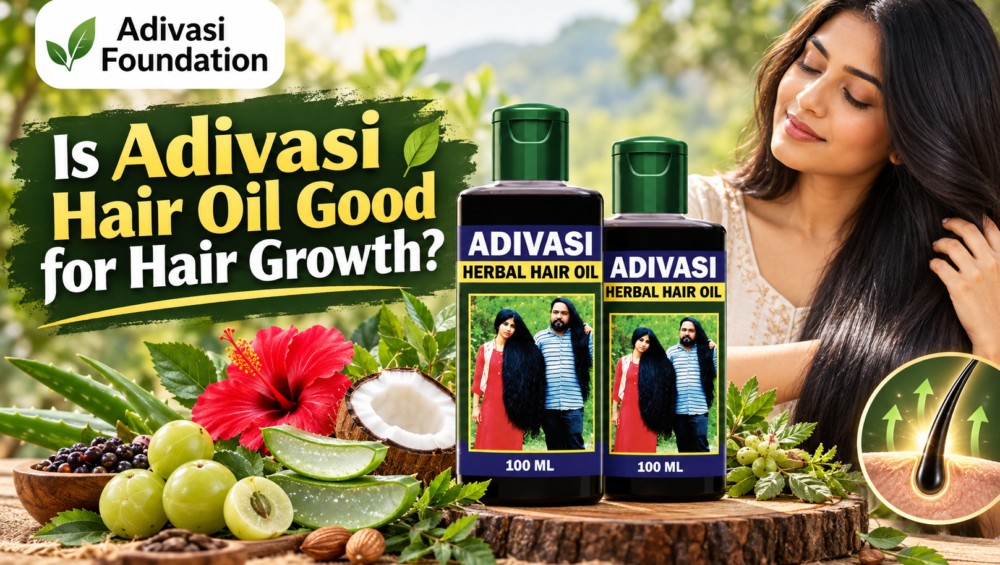
Hair growth depends on several factors, including scalp condition, nutrition, genetics, daily hair-care habits, stress, hormonal balance, and the way hair is handled. Alongside these factors, regular oiling can support a healthy scalp environment and help reduce dryness, roughness, and breakage. This is one reason traditional herbal hair oils continue to attract attention.
Adivasi hair oil is commonly associated with herbal ingredients and traditional hair-care practices. People often use it to nourish the scalp, strengthen the appearance of hair, and maintain healthier-looking strands. However, its role in supporting hair growth needs to be considered realistically rather than through exaggerated claims.
What Is Adivasi Hair Oil?
Adivasi hair oil generally refers to herbal hair oils inspired by traditional plant-based hair-care practices associated with indigenous communities. Depending on the manufacturer and formulation, these oils may contain combinations of herbs, leaves, roots, seeds, flowers, and carrier oils.
Commonly used botanical ingredients in herbal hair oils may include:
- Amla
- Bhringraj
- Brahmi
- Hibiscus
- Neem
- Fenugreek
- Curry leaves
- Aloe vera
- Coconut oil
- Sesame oil
- Castor oil
The exact formula can vary considerably between products. Therefore, users should always check the ingredient list rather than assuming that every product marketed under the same category contains identical herbs.
At Adivasi Foundation, traditional hair-care practices can be approached as part of a consistent routine rather than as an instant solution for every type of hair problem.
Is Adivasi Hair Oil Good for Hair Growth?
Adivasi hair oil may support healthier hair and scalp conditions when used correctly and consistently. Oiling can help moisturise the scalp, reduce friction between hair strands, improve manageability, and protect dry lengths from unnecessary breakage.
However, applying hair oil does not automatically mean that new hair will grow faster.
Hair originates from follicles beneath the scalp. Factors such as genetics, nutritional deficiencies, hormones, ageing, medical conditions, medications, and scalp disorders can affect the natural hair-growth cycle.
Therefore, Adivasi hair oil is better viewed as a supportive hair-care product rather than a guaranteed treatment for hair loss.
Regular scalp massage combined with suitable oil may also help users maintain a consistent scalp-care routine. When hair becomes less dry and breaks less frequently, it may appear longer, thicker, and healthier over time.
Many people searching for Adivasi Hair Oil for Hair Growth are primarily looking for stronger hair, reduced breakage, improved scalp nourishment, and better hair retention. These are realistic areas where an appropriate oiling routine may offer cosmetic and conditioning benefits.
How Can Adivasi Hair Oil Support Healthy Hair?
The potential benefits of herbal hair oil depend largely on its formulation and how it is used. Different botanical ingredients may provide different conditioning properties.
1. Helps Nourish a Dry Scalp
A dry scalp can feel tight, uncomfortable, flaky, or rough. Applying oil can form a protective layer over the scalp and help reduce moisture loss.
Carrier oils such as coconut, sesame, or other plant oils may help soften the scalp when dryness is associated with environmental exposure or frequent washing.
Keeping the scalp comfortable can support better overall hair-care habits.
2. Helps Reduce Hair Breakage
Hair may appear to be growing slowly when the ends continuously break.
Long hair strands are repeatedly exposed to:
- Washing
- Combing
- Heat styling
- Sunlight
- Pollution
- Friction from clothing
- Tight hairstyles
- Chemical treatments
Hair oil can improve lubrication between strands and make dry hair feel smoother. This may reduce mechanical damage during brushing, washing, and styling.
Reducing breakage can help users retain more length even though the natural follicle growth rate remains unchanged.
3. Improves Hair Manageability
Tangled hair is more likely to break during combing.
Proper oiling can make dry or coarse hair easier to manage by coating the hair shaft and reducing friction. This can be particularly useful before shampooing.
Better manageability may also reduce aggressive brushing, which can otherwise contribute to damaged ends and unnecessary hair loss caused by breakage.
4. Supports a Regular Scalp Massage Routine
Massaging hair oil gently into the scalp can be relaxing and may temporarily increase local blood circulation.
The massage should remain gentle. Excessive rubbing, scratching, or pulling can irritate the scalp and weaken fragile hair.
Using fingertips rather than fingernails is usually preferable.
A short, comfortable massage is sufficient. There is no need to apply excessive pressure in an attempt to stimulate faster growth.
Can Adivasi Hair Oil Make Hair Grow Faster?
Hair oil should not be expected to dramatically alter the biological speed at which hair follicles produce hair.
The scalp contains thousands of follicles, each operating through its own growth cycle. The cycle includes active growth, transition, resting, and shedding phases.
Hair oil mainly works on the scalp surface and existing hair shafts. Therefore, its most noticeable effects are generally associated with conditioning rather than changing follicle biology.
A well-formulated herbal oil may help support:
- Scalp moisturisation
- Softer hair
- Reduced dryness
- Improved shine
- Reduced friction
- Better manageability
- Reduced breakage
These improvements can make hair look fuller or help it maintain length more effectively.
What Ingredients Should You Look for in Adivasi Hair Oil?
The ingredient list is more important than marketing claims. A product labelled as herbal should clearly state what it contains.
Amla
Amla has a long history of use in traditional Indian hair care. It is often included in herbal oils intended for scalp nourishment and conditioning.
Bhringraj
Bhringraj is another commonly used botanical ingredient in traditional hair-care preparations. It is frequently combined with carrier oils for scalp massage.
Brahmi
Brahmi is often included in herbal formulations intended for scalp conditioning and traditional wellness routines.
Hibiscus
Hibiscus flowers and leaves are commonly used in traditional hair applications. Hibiscus-based preparations may help make hair feel softer and smoother.
Fenugreek
Fenugreek seeds are frequently incorporated into homemade and commercially prepared herbal hair oils. They are mainly valued as part of conditioning hair-care routines.
Coconut Oil
Coconut oil is widely used for hair because it can coat and penetrate hair fibres to some extent. It may help reduce protein loss from hair under certain conditions and is commonly used before shampooing.
Sesame Oil
Sesame oil is frequently used as a carrier oil in traditional formulations. It provides lubrication and helps herbal ingredients spread easily across the scalp and hair.
How Should Adivasi Hair Oil Be Used for Hair Care?
Correct application can make an oiling routine more comfortable and practical.
Start by using a moderate quantity. Applying a very large amount does not necessarily provide better results and may simply make shampooing more difficult.
Step 1: Detangle the Hair
Gently remove major knots before applying oil. Avoid aggressive brushing if the hair is extremely dry or fragile.
Step 2: Apply Oil to the Scalp
Divide the hair into sections and place small amounts of oil across the scalp.
There is no requirement to saturate every part of the scalp.
Step 3: Massage Gently
Massage the scalp using fingertips for several minutes.
Avoid using fingernails because scratching can irritate the scalp.
Step 4: Apply Oil Through the Lengths
If the hair is dry, apply a small amount through the mid-lengths and ends.
The ends usually experience the greatest amount of wear, making them particularly vulnerable to breakage.
Step 5: Leave It for a Suitable Period
Many people prefer leaving hair oil on for around 30 minutes to a few hours before washing.
Leaving oil overnight is not essential. People with sensitive or acne-prone skin may prefer shorter application periods.
Step 6: Wash Thoroughly
Use a suitable shampoo to remove excess oil.
Heavy scrubbing is unnecessary. If required, shampoo twice using gentle movements rather than applying excessive friction.
How Often Should You Use Adivasi Hair Oil?
The appropriate frequency varies according to hair type, scalp condition, hairstyle, climate, and personal preference.
For many users, applying hair oil once or twice a week may be sufficient.
People with very dry hair may prefer more frequent use, while those with oily scalps may require less frequent application.
The scalp’s response should determine the routine.
Reduce or stop application if the oil causes:
- Persistent itching
- Redness
- Burning
- Increased flaking
- Scalp bumps
- Facial acne near the hairline
- Unusual irritation
A patch test can also be useful before applying a new herbal product extensively.
Can Adivasi Hair Oil Reduce Hair Fall?
The term “hair fall” can describe several different situations.
Some people are experiencing hair breakage, while others are experiencing shedding directly from the follicle.
Oil may help reduce breakage by improving lubrication and flexibility. However, it may not correct hair shedding associated with internal causes.
Common reasons for excessive shedding can include:
- Nutritional deficiencies
- Major physical stress
- Hormonal changes
- Thyroid conditions
- Certain medications
- Scalp diseases
- Genetic hair loss
- Significant weight loss
- Illness or surgery
If shedding becomes severe, appears suddenly, creates visible bald patches, or continues for an extended period, professional medical assessment is advisable.
How Long Does Adivasi Hair Oil Take to Show Results?
Hair-care results should be evaluated gradually.
Improvements in softness and manageability may become noticeable fairly quickly, while reduced breakage usually requires several weeks of consistent care.
Evaluating actual changes in hair length or density requires considerably more time because hair grows gradually.
Instead of checking the mirror every few days, users can assess progress through photographs taken under similar lighting every four to eight weeks.
Useful signs of improvement may include:
- Fewer broken strands
- Less tangling
- Softer ends
- Improved shine
- Better scalp comfort
- Easier combing
- Better length retention
Hair density changes should be assessed separately because they depend on follicle activity rather than only surface conditioning.
Does Adivasi Hair Oil Work for Every Hair Type?
Herbal oil can be used across several hair types, but the amount and frequency should be adjusted.
Dry Hair
Dry hair may benefit from moderate oil application across both the scalp and lengths before shampooing.
Oily Hair
People with naturally oily scalps may prefer small quantities and shorter application periods.
Curly Hair
Curly and textured hair often experiences greater dryness along the lengths because natural scalp oils do not travel down curled strands as easily.
Applying small amounts of oil to the ends may improve manageability.
Fine Hair
Fine hair can become weighed down easily. Light application is usually more suitable than heavy saturation.
Chemically Treated Hair
Coloured, straightened, or chemically treated hair can be fragile. Oil may help improve softness, but damaged hair also requires gentle cleansing, conditioning, heat protection, and limited chemical processing.
Can Men and Women Both Use Adivasi Hair Oil?
Yes. Hair oil is not restricted by gender.
The decision to use it should be based on scalp condition, hair texture, personal preference, and ingredient tolerance.
Men experiencing a dry scalp or rough hair may use it as part of their grooming routine. Women with long, curly, dry, or chemically treated hair may also use oil primarily for conditioning and breakage reduction.
However, anyone experiencing noticeable thinning or progressive hair loss should consider obtaining professional advice rather than relying only on cosmetic products.
What Else Supports Healthy Hair Growth?
Hair oil works best as one part of a broader hair-care routine.
Eat a Balanced Diet
Hair follicles require adequate nutrition.
A balanced diet should contain suitable amounts of:
- Protein
- Iron
- Zinc
- Essential fatty acids
- Vitamins
- Minerals
Unnecessary supplementation should be avoided unless a deficiency is identified or a qualified healthcare professional recommends it.
Avoid Excessive Heat
Frequent use of straighteners, curling tools, and high-temperature blow-drying can weaken the hair shaft.
Using lower temperatures and limiting heat exposure may reduce breakage.
Avoid Very Tight Hairstyles
Repeated tension from tight ponytails, braids, buns, extensions, or similar styles can place unnecessary stress on the hairline and follicles.
Looser hairstyles can help reduce mechanical strain.
Wash According to Scalp Needs
There is no universal washing frequency suitable for everyone.
An oily scalp may need more frequent cleansing, while dry or curly hair may require a different schedule.
Keeping the scalp reasonably clean helps remove excess oil, sweat, styling products, and environmental residue.
Handle Wet Hair Carefully
Wet hair can be vulnerable to stretching and breakage.
Use gentle detangling methods and avoid unnecessary pulling.
How Can You Choose Original Adivasi Hair Oil?
Consumer interest in traditional hair oils has resulted in numerous products being sold under similar names.
Buyers should examine several points before purchasing:
- Complete ingredient list
- Manufacturer details
- Batch number
- Manufacturing date
- Expiry or best-before information
- Appropriate labelling
- Packaging quality
- Seller credibility
- Storage instructions
- Contact information
Avoid products making extreme promises such as immediate regrowth, permanent reversal of baldness, or dramatic hair growth within a few days.
Hair biology does not normally work that way.
Adivasi Foundation encourages consumers to focus on transparent product information and realistic hair-care expectations rather than unsupported promotional claims.
Common Mistakes While Using Hair Oil
Even a suitable hair oil may provide a poor experience when used incorrectly.
Applying Too Much Oil
More oil does not automatically mean more nourishment. Excess application can make cleansing difficult and leave residue behind.
Massaging Aggressively
Hard rubbing may irritate the scalp and increase breakage.
Keeping Oil on an Irritated Scalp
If the scalp already has inflammation, open wounds, or an active skin problem, applying new products without professional advice may worsen irritation.
Expecting Immediate Regrowth
Visible hair growth requires time. Cosmetic products should not be expected to produce overnight changes.
Ignoring Lifestyle Factors
Sleep, nutrition, stress management, medical conditions, and daily styling habits can influence hair quality.
Hair oil cannot compensate for every factor affecting the hair-growth cycle.
When Should Hair Loss Be Checked by a Professional?
Mild shedding is a normal part of the hair cycle. However, certain changes deserve attention.
Seek appropriate medical evaluation if you notice:
- Sudden heavy shedding
- Circular bald patches
- Rapid thinning
- Visible scalp areas becoming wider
- Persistent scalp inflammation
- Scaling or painful lesions
- Hair loss after starting medication
- Hair thinning associated with unexplained fatigue or weight changes
- Progressive recession of the hairline
Identifying the cause is important because different types of hair loss require different approaches.
Final Thoughts
Adivasi hair oil can be a useful addition to a regular hair-care routine, particularly for scalp moisturisation, smoother strands, improved manageability, and reduced breakage. These benefits may indirectly support better length retention and healthier-looking hair.
However, no hair oil can guarantee new hair growth for every person. Hair growth is influenced by genetics, nutrition, hormones, health conditions, and follicle activity. Adivasi Foundation supports a balanced approach in which traditional oiling practices are combined with gentle hair care, good nutrition, realistic expectations, and professional advice when persistent hair loss occurs.
FAQs
How often should I use Adivasi hair oil for hair growth?
Many people can use Adivasi hair oil once or twice a week, depending on scalp type and hair condition. Dry hair may benefit from more regular oiling, while naturally oily scalps may require less frequent application. Adjust the routine according to how the scalp responds.
How long should Adivasi hair oil stay on the scalp?
Adivasi hair oil can usually be left on for around 30 minutes to a few hours before shampooing. Overnight application is optional rather than essential. People with sensitive or acne-prone skin may prefer shorter application periods to minimise the chance of irritation.
Can Adivasi hair oil reduce hair fall?
Adivasi hair oil may help reduce hair breakage by improving lubrication and softness. However, excessive shedding from the follicle may be related to nutrition, hormones, genetics, illness, medication, or scalp conditions. Persistent or sudden hair loss should be assessed by an appropriate healthcare professional.