
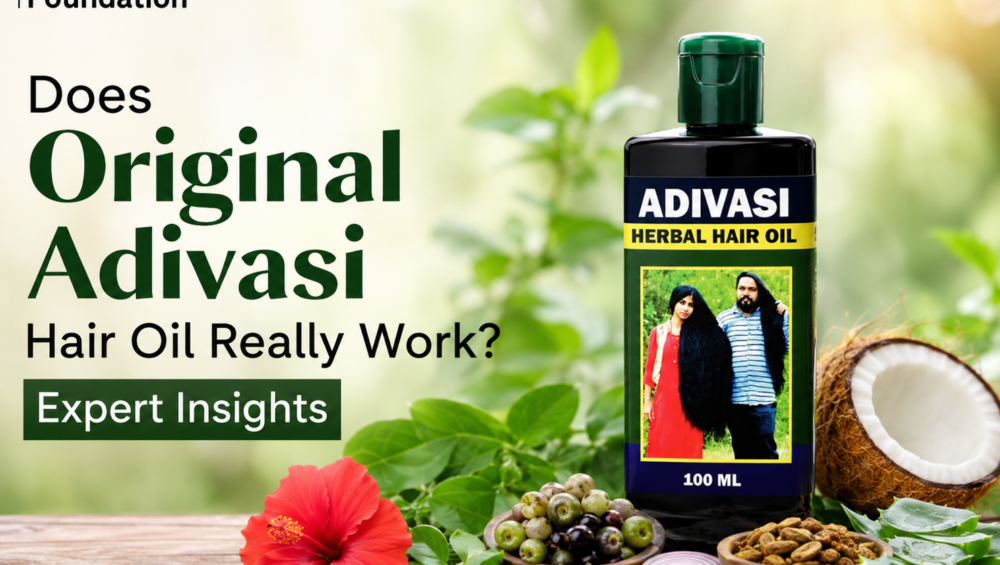
Hair oiling has remained a familiar part of Indian hair-care routines for generations. Yet, with the growing number of herbal oils available online and offline, one question comes up repeatedly: Does Original Adivasi Hair Oil really work?
The honest answer depends on what “work” means.
If the expectation is softer hair, improved manageability, reduced dryness, better shine, and protection against some forms of hair damage, a well-formulated hair oil can certainly have a useful role. If the expectation is that an oil alone will reverse genetic baldness, permanently stop hair loss, or create dramatic new growth within a few weeks, the evidence is far less convincing.
For Adivasi Foundation, responsible hair care means separating traditional use, cosmetic benefits, consumer experience, and scientific evidence. Hair oils should be evaluated for what they can realistically contribute rather than being judged by exaggerated promises.
What Is Original Adivasi Hair Oil?
The phrase “Original Adivasi Hair Oil” is often used by consumers searching for a traditional, plant-based hair-care formulation associated with indigenous herbal practices. However, the name alone does not establish a standardized formula.
Different products sold under similar names may have different ingredients, extraction methods, carrier oils, concentrations, manufacturing standards, and quality controls. That distinction matters.
A product should therefore be assessed by its actual ingredient declaration, manufacturer information, batch details, usage directions, packaging, and quality credentials, rather than by the name printed on the bottle.
Adivasi Foundation presents its hair-care philosophy around natural ingredients and traditional practices, while also emphasizing that results can vary according to hair type, scalp condition, consistency of use, lifestyle, and overall hair health.
So, Does Original Adivasi Hair Oil Really Work?
It can be useful as part of a sensible hair-care routine, but its benefits should be described realistically.
Hair oil primarily works on the hair fibre and scalp environment. It can lubricate strands, reduce friction during grooming, improve softness, and make hair look shinier and healthier. Certain oils can also help protect the hair shaft from damage.
A systematic review published in the Journal of Drugs in Dermatology examined 22 studies involving coconut, castor, and argan oils. The researchers found evidence supporting coconut oil for brittle hair and hair protection, while evidence for actual hair growth was limited. The review also found weak evidence for castor oil improving hair quality and no strong evidence that it promotes hair growth.
That distinction is important.
Healthy-looking hair and new follicular growth are not the same thing.
A person may notice less breakage, smoother strands, improved shine, or better manageability after regularly oiling the hair. Those changes can make hair appear fuller or longer. But that does not automatically mean dormant follicles have been activated.
What Can a Good Hair Oil Actually Do?
A quality hair oil may provide several practical benefits.
1. Helps reduce dryness
Oils can create a protective layer around the hair fibre. This can improve the feel of dry, rough strands and make them easier to manage.
Dryness is particularly noticeable when hair is frequently exposed to heat styling, colouring, chemical treatments, excessive washing, sun exposure, or mechanical friction.
2. Supports hair-shaft protection
Coconut oil has received more scientific attention than many other commonly used hair oils. Research suggests that topical coconut oil may help reduce protein loss associated with grooming and other forms of hair damage.
A 2024 presentation in the British Journal of Dermatology similarly reported stronger evidence for coconut-based hair oils in protective roles, including reducing hair porosity and improving tensile strength, while noting that evidence for hair growth remains limited.
3. Improves shine and manageability
Oil smooths the surface of hair fibres, which can reduce the rough appearance of strands. The result may be visibly shinier and more manageable hair.
This is a cosmetic benefit, but it is still valuable.
4. May reduce breakage
When hair becomes dry and brittle, repeated combing and styling can cause breakage. Lubrication can reduce friction between strands and during grooming.
For someone whose “hair fall” is actually a combination of shedding and breakage, improving hair care practices may make a noticeable difference.
Does Hair Oil Regrow Lost Hair?
This is where expectations need to be realistic.
There is currently no strong scientific basis for claiming that a generic herbal hair oil can universally regenerate lost hair or reverse every type of baldness.
Hair loss has many possible causes. Genetics, hormonal influences, nutritional deficiencies, stress, certain illnesses, scalp disorders, medications, inflammation, and physical damage can all play a role.
Pattern hair loss, for example, involves biological changes within susceptible hair follicles. Simply applying oil to the scalp does not necessarily address the mechanism responsible for follicle miniaturisation.
This is why persistent or rapidly progressing hair loss deserves professional evaluation rather than relying solely on cosmetic products.
At the same time, it would be inaccurate to say that all hair oils are useless for hair-growth-related concerns. Some specific formulations have been clinically studied. A 2025 randomized controlled study of a particular Bringha hair oil formulation reported improvements in hair density and reductions in hair-fall counts over four months. However, evidence for one tested formulation should not automatically be transferred to every product carrying a similar herbal label.
That is an important principle for professionals and informed consumers: evidence belongs to the tested formulation, not merely to a category name.
Why Ingredient Quality Matters
Two bottles may both be marketed as herbal hair oils but deliver very different experiences.
Ingredient quality depends on factors such as:
- Botanical identity
- Purity of raw materials
- Extraction method
- Concentration
- Carrier oil quality
- Manufacturing conditions
- Storage
- Packaging
- Product stability
- Batch consistency
The number of herbs listed on a label does not automatically indicate superior performance.
A formulation containing dozens of botanicals may sound impressive, but a long ingredient list is not itself proof of efficacy. Experts have also questioned broad claims made around heavily marketed Adivasi hair oils, particularly when specific formulations lack controlled clinical evidence.
For professionals evaluating a product, traceability and formulation transparency are more meaningful than simply counting ingredients.
Traditional Ingredients: What Should Consumers Expect?
Many traditional Indian hair-care formulations incorporate botanicals such as amla, bhringraj, hibiscus, fenugreek, neem, curry leaves, and other plant materials.
These ingredients have long histories of traditional use. Some also have biochemical properties that make them interesting subjects for cosmetic and dermatological research.
However, traditional use and clinical proof are different standards.
For example, an ingredient may have antioxidant or antimicrobial activity in laboratory research, yet that does not prove that applying a particular oil containing that ingredient will reverse hereditary hair loss.
This distinction protects consumers from both extremes: dismissing traditional practices without consideration and accepting every traditional claim without evidence.
Can Original Adivasi Hair Oil Help With Hair Fall?
The answer depends on what is causing the hair fall.
If the concern is primarily hair breakage, dryness, roughness, or mechanical damage, an appropriate oiling routine may help protect existing strands.
If the problem is excessive shedding from the roots, the cause needs to be considered.
If hair loss is associated with nutritional problems, hormonal factors, autoimmune conditions, scalp infection, medication, severe stress, or genetic pattern hair loss, an oil may not address the underlying reason.
A useful way to assess results is therefore to ask:
Is the hair breaking, or is the follicle shedding the hair?
These are not identical problems.
People sometimes interpret fewer broken strands on a comb as proof that an oil has stopped biological hair loss. The improvement may be real, but the mechanism can be different.
What About Dandruff and an Oily Scalp?
More oil is not necessarily better for every scalp.
People with dandruff-prone or oily scalps may find heavy oiling uncomfortable. Excess oil can also make the scalp feel greasy and may aggravate symptoms in some individuals.
A 2026 medical review of coconut oil notes that it can be useful for dry or damaged hair but may not suit everyone, particularly people experiencing scalp acne, irritation, or dandruff-related problems.
Therefore, application frequency should depend on individual tolerance rather than a fixed rule that everyone must oil daily.
If there is persistent itching, redness, scaling, painful areas, pus, sudden shedding, or patchy hair loss, professional assessment is more appropriate than repeatedly adding oil.
How Should You Use a Hair Oil?
For routine hair care, moderation is usually more practical than excessive application.
Start with an appropriate amount and distribute it gently through the scalp and hair. Avoid aggressive scratching or forceful massage, particularly if the scalp is sensitive.
The length of time the oil remains on the hair can depend on the formulation and personal preference. It is not necessary to assume that leaving an oil overnight will automatically make it more effective.
A practical routine can involve:
- Applying a moderate quantity.
- Gently massaging rather than aggressively rubbing.
- Distributing some oil through dry lengths when needed.
- Allowing suitable contact time.
- Washing thoroughly with an appropriate cleanser.
- Monitoring how the scalp and hair respond.
Consistency matters, but consistency with an unsuitable product is not beneficial. If a product causes itching, burning, redness, increased flaking, or discomfort, discontinue use and seek professional advice if symptoms persist.
How Long Does It Take to See Results?
Hair quality changes and hair-growth changes should not be judged on the same timeline.
Softness and shine may be noticed relatively quickly because they are cosmetic effects on the hair fibre.
Reduced breakage may take longer to appreciate because it depends on grooming habits and cumulative damage.
Changes in hair density are much slower and should be evaluated over months rather than days. Even clinically studied hair treatments generally require sustained use before meaningful changes can be assessed.
This is why promises of dramatic hair regrowth within a few days or a couple of weeks should be treated cautiously.
Original Product vs. Unverified Sellers
When consumers search for Original Adivasi Hair Oil, authenticity is an important consideration.
Popular product names can attract duplicate listings, misleading advertisements, and products with inconsistent formulations. Some reporting on Adivasi hair oils has also highlighted concerns about imitation products and unclear ingredient disclosure.
Consumers should look for:
- A clearly identified manufacturer
- Complete ingredient information
- Batch or lot details
- Manufacturing and expiry information
- Proper packaging
- Customer-support information
- Appropriate regulatory or quality information where applicable
- A reliable purchase source
Avoid making a purchasing decision solely because a seller claims that its product is “original,” “100% natural,” or made with an unusually high number of herbs.
Authenticity should be supported by verifiable product information.
Expert Perspective: What Should Professionals Look For?
For industry professionals, the most useful question is not simply whether a hair oil “works.”
The better questions are:
What is the intended benefit?
Which ingredients are responsible for that benefit?
What evidence supports the formulation?
How is product quality maintained from raw material to finished bottle?
What claims can reasonably be communicated to consumers?
A responsible hair-care brand should distinguish cosmetic conditioning claims from medical treatment claims.
For example, saying that an oil can help hair feel softer is fundamentally different from claiming that it can cure baldness.
The first can be assessed through cosmetic performance. The second requires substantially stronger clinical evidence.
This distinction is especially important as consumers become more interested in botanical and traditional formulations.
What Results Should You Realistically Expect?
A realistic expectation from a well-formulated hair oil is healthier-feeling and better-conditioned hair, improved shine, reduced dryness, and potentially less breakage when used appropriately.
Some people may also feel that regular scalp massage contributes to a relaxing self-care routine.
What should not be assumed is that every herbal oil will reverse hereditary baldness, repair permanently damaged follicles, or treat an underlying scalp disease.
The evidence surrounding hair oils is mixed. A systematic review found useful evidence for certain aspects of hair quality, particularly with coconut oil, but limited evidence for direct hair-growth effects.
That balanced view is more useful than either promising miraculous results or dismissing every botanical formulation.
Final Verdict
Does Original Adivasi Hair Oil really work?
It can work as a hair-care product when the goal is nourishment, conditioning, softness, shine, manageability, and protection against certain types of hair-shaft damage. The potential value depends heavily on the actual formulation, ingredient quality, scalp condition, and how the product is used.
However, there is a major difference between supporting healthy-looking hair and treating medical hair loss.
Consumers should not expect an oil to solve every cause of shedding or baldness. Persistent, sudden, patchy, or severe hair loss should be evaluated by a qualified dermatologist or other appropriate healthcare professional.
At Adivasi Foundation, the stronger approach is to combine respect for traditional herbal hair-care practices with realistic expectations, ingredient transparency, responsible product use, and evidence-aware communication.
A good hair oil does not need extraordinary promises to have a useful place in a hair-care routine. Its value is better judged by formulation quality, appropriate use, consistency, and the results that can reasonably be expected.
FAQs
Can Original Adivasi Hair Oil stop hair fall?
It may help reduce hair breakage and improve the condition of existing strands. However, hair shedding can have many causes, including genetic, hormonal, nutritional, inflammatory, and medical factors. An oil alone may not address the underlying cause.
How often should I use Original Adivasi Hair Oil?
Use it according to the product's directions and your scalp's tolerance. Excessive oiling is not necessarily more effective. People with oily, dandruff-prone, or sensitive scalps may need a different routine.
How can I identify genuine Original Adivasi Hair Oil?
Check the manufacturer's information, ingredient declaration, batch details, expiry information, packaging, and purchase source. Avoid relying solely on claims such as “100% original,” “miracle growth,” or unusually large herb counts. A genuine product should have clear and verifiable product information.