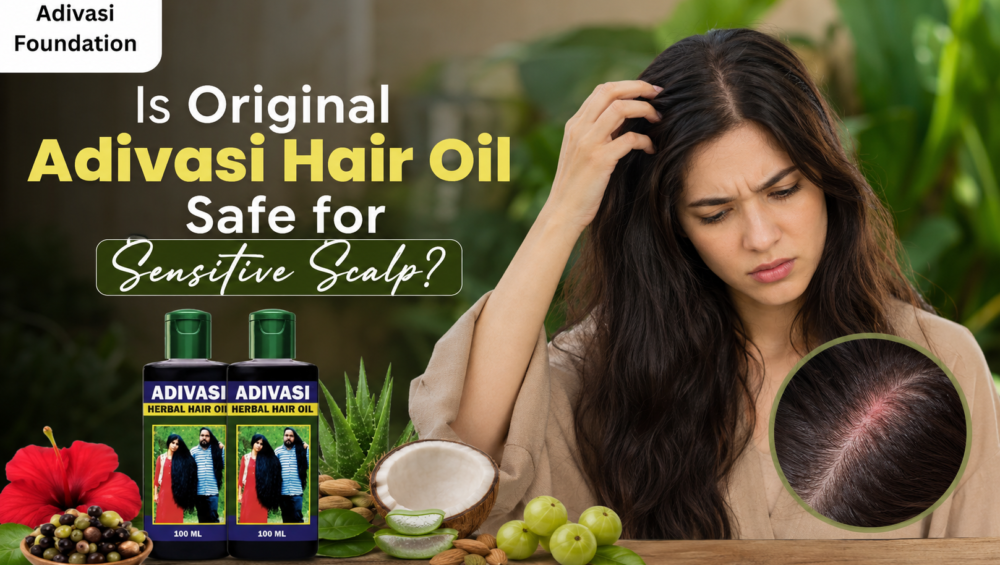
A sensitive scalp can make choosing hair-care products difficult. A formula that feels comfortable for one person may cause itching, redness, dryness, or irritation for another. This concern becomes particularly relevant when using herbal oils that contain multiple plant-based ingredients.
People considering Original Adivasi Hair Oil often want to know whether it can fit into a sensitive-scalp routine without creating discomfort. The answer depends on several factors, including the ingredient formulation, individual sensitivities, existing scalp condition, application method, and frequency of use.
Adivasi Foundation encourages careful, informed hair-care choices, especially for people whose scalp reacts easily.
What Does a Sensitive Scalp Mean?
A sensitive scalp generally refers to a scalp that reacts more easily to certain products, environmental conditions, or grooming practices. People may notice itching, tightness, burning, tenderness, redness, dryness, or general discomfort.
Scalp sensitivity does not have one universal cause. Hair-care products, excessive cleansing, fragrances, certain preservatives, hair dyes, heat, friction, and underlying skin conditions can contribute to scalp irritation.
Hair and scalp products can potentially trigger either irritant or allergic contact dermatitis in susceptible people. Research reviewing scalp-applied products has identified itching, burning, and eczema-like lesions among possible signs of allergic contact dermatitis.
This is why someone with a sensitive scalp should evaluate any new hair oil according to personal tolerance rather than assuming that a product will suit everyone.
Is Original Adivasi Hair Oil Suitable for Sensitive Scalp?
Whether Original Adivasi Hair Oil is suitable for a particular sensitive scalp depends primarily on its actual ingredient list and the individual’s response to those ingredients.
The word “herbal” or “natural” should not automatically be interpreted as “non-irritating.” Botanical ingredients can still cause sensitivity in certain individuals. The American Academy of Dermatology also notes that plant-based products may contain components capable of causing skin reactions in susceptible users.
Therefore, people with sensitive scalps should check the product label carefully before use. Look at the complete ingredient list rather than relying only on front-label claims.
If you have previously experienced reactions to particular herbs, fragrances, essential oils, preservatives, or other cosmetic ingredients, avoid formulas containing known triggers.
Why Herbal Hair Oils Appeal to Sensitive-Scalp Users
Herbal hair oils have remained popular because many consumers prefer simple hair-care routines inspired by traditional botanical practices. Oils can also help lubricate the hair shaft and make scalp massage easier.
For someone with scalp sensitivity, however, more ingredients do not necessarily mean better results. A highly complex herbal mixture introduces more substances to which sensitive skin may potentially react.
The most appropriate formula is one that the individual can tolerate comfortably.
Consumers should therefore focus on three things: ingredient transparency, careful application, and the scalp’s response after use.
Check the Ingredient List Before Applying Hair Oil
Reading the ingredient label is particularly important for people with sensitive skin.
Pay attention to carrier oils, botanical extracts, fragrances, essential oils, preservatives, and any additional cosmetic ingredients. If an unfamiliar ingredient appears on the label, find out what it is before putting the product across your entire scalp.
Fragrance deserves particular attention. Dermatology sources identify fragrance among common triggers of allergic contact dermatitis.
This does not mean every fragranced hair oil will irritate every sensitive scalp. It means individuals with known fragrance sensitivity should take extra care.
People who have previously received professional allergy testing should compare the product label with their known allergens.
Why a Patch Test Matters
A cautious trial can help you assess how your skin responds before applying a new product widely.
The American Academy of Dermatology recommends testing new skin-care products on a small area twice daily for seven to ten days when appropriate. If redness, itching, or swelling develops, the product should not be continued.
Hair oils can be slightly different from leave-on skin products because they may be used according to specific label directions. Follow the manufacturer’s directions and seek professional advice when you already have a history of significant reactions.
Do not assume that a single irritation-free application guarantees permanent tolerance. Allergic contact dermatitis can sometimes appear after repeated exposure.
How to Start Using Hair Oil on a Sensitive Scalp
If a small-area trial causes no discomfort and you decide to proceed, start conservatively.
Avoid covering your scalp with a large amount during the first application. Apply a modest quantity and massage it gently without aggressive rubbing.
Pay attention to how your scalp feels during application and afterward.
Mild warmth created by massage should not be confused with persistent burning, intense itching, or pain. If uncomfortable symptoms begin after applying the oil, wash it off and stop using it until you can determine the cause.
The NHS notes that avoiding an identified irritant or allergen is an important part of managing contact dermatitis.
Avoid Aggressive Scalp Massage
Scalp massage can be relaxing, but excessive pressure is unnecessary.
People with sensitive scalps should use their fingertips gently rather than scratching with their nails. Vigorous rubbing can aggravate skin that is already irritated.
Apply enough pressure to distribute the oil without creating friction.
This approach is especially important if the scalp already feels dry or tight. More aggressive massage will not necessarily produce better hair-care results.
A gentle routine usually provides a more practical way to assess whether the oil itself feels comfortable.
Do Not Apply Hair Oil to an Already Irritated Scalp
If your scalp is actively inflamed, scratched, blistered, unusually painful, or covered with a new rash, introducing another product can make identifying the cause more difficult.
Wait until you know why the irritation is occurring.
An itchy scalp can have many causes, and allergic contact dermatitis is only one possibility. The American Academy of Dermatology advises stopping a product suspected of causing an itchy scalp reaction and seeking dermatological help when identifying the trigger is difficult.
Persistent scalp problems should not be treated solely through cosmetic experimentation.
Sensitive Scalp and Dry Scalp Are Not Always the Same
People frequently use “dry scalp” and “sensitive scalp” interchangeably, but they describe different concerns.
A dry scalp primarily lacks sufficient moisture or oil and may feel tight or flaky. A sensitive scalp is more about increased reactivity and may involve itching, burning, redness, or discomfort after exposure to certain triggers.
Someone can have both conditions at once.
This distinction matters when choosing Original Adivasi Hair Oil because adding oil may make hair feel conditioned without addressing the reason behind persistent scalp irritation.
If flakes, inflammation, sores, severe itching, or recurring discomfort continue, seek professional assessment rather than assuming dryness is the only issue.
Can Herbal Ingredients Cause Scalp Reactions?
Yes. Plant-derived ingredients can cause reactions in susceptible individuals.
The assumption that natural ingredients cannot cause irritation is inaccurate. Contact dermatitis can occur after exposure to many different substances, including some plants and cosmetic ingredients.
Individual tolerance varies considerably.
A botanical ingredient that works comfortably for thousands of users can still cause a reaction in someone who is sensitive or allergic to it.
For this reason, product safety should be viewed individually. Ingredient quality matters, but personal skin tolerance matters as well.
What Signs Suggest That a Hair Oil Does Not Suit Your Scalp?
Your scalp usually provides useful signals when a product does not suit it.
Watch for persistent itching, burning, unusual tenderness, redness, swelling, rash, blisters, worsening dryness, or discomfort that develops after application.
Contact dermatitis can cause itchy, dry, cracked, or blistered skin and may appear within hours or days after exposure to an irritant or allergen.
If symptoms begin soon after introducing a new hair oil, stop using the product rather than repeatedly applying it to “see if the scalp adjusts.”
If symptoms are severe, persistent, spreading, or recurring, consult a dermatologist.
What If Irritation Appears After Several Uses?
Not every reaction happens during the first application.
Allergic contact dermatitis can involve sensitization, meaning a person may become reactive to a substance after previous exposure. The NHS explains that an individual can become sensitized to an allergen and develop symptoms after subsequent contact.
Therefore, pay attention to changes over time.
If your scalp was comfortable initially but later develops repeated itching or redness after oiling, stop the product and consider whether something in your routine has changed.
Also consider shampoo, conditioner, hair dye, styling products, fragrances, and other products touching the scalp.
How Often Should People With Sensitive Scalps Oil Their Hair?
There is no universal oiling schedule that suits every sensitive scalp.
Frequency should depend on individual comfort, hair type, scalp condition, product instructions, and washing routine.
Rather than immediately adopting frequent oiling, begin with occasional use and observe the scalp.
If your scalp remains comfortable, you can decide whether the routine suits you. If repeated application causes buildup, itching, tenderness, or discomfort, reduce the frequency or stop using the product.
Sensitive-scalp care should prioritize tolerance over rigid routines.
Should You Leave Hair Oil Overnight?
Overnight oiling is not automatically necessary.
Some people prefer applying oil for a limited period before washing, while others tolerate longer application. For sensitive scalps, longer contact means prolonged exposure to every ingredient in the formula.
Follow the product’s stated directions.
If you are testing a new formula, a conservative approach may make it easier to monitor your scalp’s response.
Do not leave a product on for longer simply because you believe additional time guarantees additional benefits.
Keep Your Overall Hair-Care Routine Simple
When testing a new oil, avoid introducing several new products simultaneously.
Suppose you start a new shampoo, conditioner, serum, hair mask, and oil during the same week. If irritation develops, determining which product caused it becomes difficult.
Instead, maintain a relatively stable routine while introducing one new product.
This approach makes observation easier and gives you a clearer idea of whether Original Adivasi Hair Oil fits comfortably into your existing hair-care routine.
Wash the Scalp Properly After Oiling
Removing excess oil is another important part of scalp care.
Use a shampoo that already suits your scalp and wash gently. Avoid repeatedly shampooing with harsh cleansers merely to achieve a squeaky-clean sensation.
Excessive cleansing can leave some people feeling dry or irritated.
At the same time, incomplete washing may leave heavy residue on certain hair and scalp types. Find a washing method that removes excess oil without creating discomfort.
Rinse thoroughly so that shampoo, conditioner, and oil residue do not remain unnecessarily on the scalp.
Avoid Using Too Many Products Together
Layering multiple products can complicate sensitive-scalp care.
For example, combining hair oil with strong styling products, fragranced serums, leave-in treatments, hair dyes, or other scalp products exposes the skin to numerous ingredients.
If a reaction develops, identifying the trigger becomes harder.
A simpler routine helps you monitor how each product affects your scalp.
This is particularly useful when introducing Original Adivasi Hair Oil for the first time.
What Should People With a History of Allergies Consider?
Anyone with a known cosmetic or botanical allergy should examine ingredient labels carefully.
A previous reaction is valuable information. Do not deliberately expose your scalp to a known allergen simply because it appears in a different type of product.
People experiencing recurrent unexplained reactions may benefit from professional patch testing. Dermatologists use patch testing to identify substances associated with allergic contact dermatitis.
Professional testing differs from a basic at-home product trial because medical patch testing assesses specific allergens under controlled conditions.
When Should You Speak With a Dermatologist?
Occasional mild scalp sensitivity may settle after removing an irritating product, but some symptoms require professional attention.
Consider speaking with a dermatologist if you experience recurring rashes, severe itching, persistent burning, swelling, painful lesions, unexplained hair loss associated with scalp inflammation, or symptoms that continue after stopping a suspected product.
The NHS recommends seeking medical advice for persistent, recurrent, or severe contact dermatitis symptoms.
A dermatologist can assess whether your symptoms relate to contact dermatitis, dandruff, eczema, psoriasis, infection, or another scalp condition.
Who Should Be Particularly Careful?
Extra caution makes sense for people who have previously experienced eczema, contact dermatitis, fragrance allergies, reactions to cosmetics, or unexplained scalp rashes.
People undergoing treatment for an existing scalp condition should also ask their dermatologist before introducing new topical products.
The same applies if the scalp has open wounds or significant inflammation.
Hair oil serves a cosmetic hair-care role. It should not replace medical treatment prescribed for a diagnosed scalp disorder.
Building a Sensible Hair-Oiling Routine
A sensitive-scalp routine does not need to be complicated.
Start by reading the complete ingredient list. Test cautiously. Introduce the oil without changing several other products simultaneously. Use a moderate quantity, massage gently, and monitor how your scalp responds.
Wash according to your hair and scalp needs rather than following a rigid schedule.
Most importantly, stop using a product when it repeatedly creates discomfort.
Adivasi Foundation supports a careful approach in which users pay attention to their individual scalp response instead of assuming one routine will suit everyone.
Final Thoughts
So, is Original Adivasi Hair Oil safe for a sensitive scalp? No hair oil can be guaranteed suitable for every sensitive scalp because reactions depend on the individual and the specific formulation.
Check the ingredients, test cautiously, use a small amount initially, and stop if itching, burning, redness, swelling, or rash appears. People with recurring sensitivity, allergies, eczema, or persistent scalp problems should consult a dermatologist before adding new topical products. A careful, personalized approach offers the most sensible way to incorporate herbal hair oil into a sensitive-scalp routine.
FAQs
Should I patch test Original Adivasi Hair Oil before using it?
A cautious small-area test is advisable for people who frequently react to new cosmetic or hair-care products. Dermatologists recommend testing new topical products before regular use when sensitivity is a concern. Anyone with a history of serious allergic reactions should seek professional advice before testing unfamiliar products.
Can Original Adivasi Hair Oil cause itching?
Any topical hair-care product can potentially cause itching in someone sensitive to one of its ingredients. If itching repeatedly develops after application, stop using the product, wash the scalp gently, and monitor the symptoms. Seek dermatological advice if the reaction persists or becomes severe.
How often can Original Adivasi Hair Oil be used on a sensitive scalp?
There is no single frequency suitable for everyone. Follow the product instructions and begin conservatively if your scalp is sensitive. Monitor for itching, redness, burning, excessive dryness, or other discomfort. Reduce or discontinue use if your scalp reacts negatively.