Hair oil remains an important part of many personal care routines, particularly for people who want to nourish the scalp, manage dryness, improve the appearance of their hair, and maintain healthier-looking strands. With numerous plant-based products available, choosing the right option can become confusing.
One comparison that frequently comes up is Original Adivasi Hair Oil vs Herbal Hair Oil. Both options are associated with botanical ingredients and traditional hair-care practices, but they are not necessarily the same type of product. Their ingredient philosophy, preparation methods, intended uses, and formulations can differ significantly.
Adivasi Foundation believes that choosing a hair oil should begin with evaluating your hair type, scalp condition, ingredients, and personal care goals rather than relying solely on product labels or promotional claims.
What Is Original Adivasi Hair Oil?
Original Adivasi Hair Oil generally refers to hair oil inspired by traditional Adivasi or tribal approaches to plant-based hair care. Such formulations may use a combination of herbs, botanical extracts, and carrier oils selected for regular scalp and hair application.
The concept is closely connected with traditional knowledge surrounding plants and natural hair-care practices. However, consumers should remember that products using similar names can have different ingredient lists and formulations.
For this reason, the word “Adivasi” on a label should not be the only factor influencing a purchase. Checking the manufacturer, ingredient information, packaging, usage instructions, and product authenticity is equally important.
At Adivasi Foundation, the focus is on helping consumers make informed choices while incorporating traditional plant-based hair care into practical routines.
What Is Herbal Hair Oil?
Herbal hair oil is a broad product category rather than one particular formulation.
A product may be described as herbal when its formulation incorporates herbs, plant extracts, botanical ingredients, or herbal infusions alongside one or more base oils. Depending on the manufacturer, herbal oils can contain ingredients such as amla, bhringraj, hibiscus, fenugreek, neem, curry leaves, aloe vera, or other botanicals.
The exact composition varies considerably from one product to another.
Some herbal oils are created mainly for scalp moisturization. Others focus on dry or rough hair, while certain formulations are intended for routine massage and general conditioning.
This means two bottles labeled “herbal hair oil” can have completely different formulations.
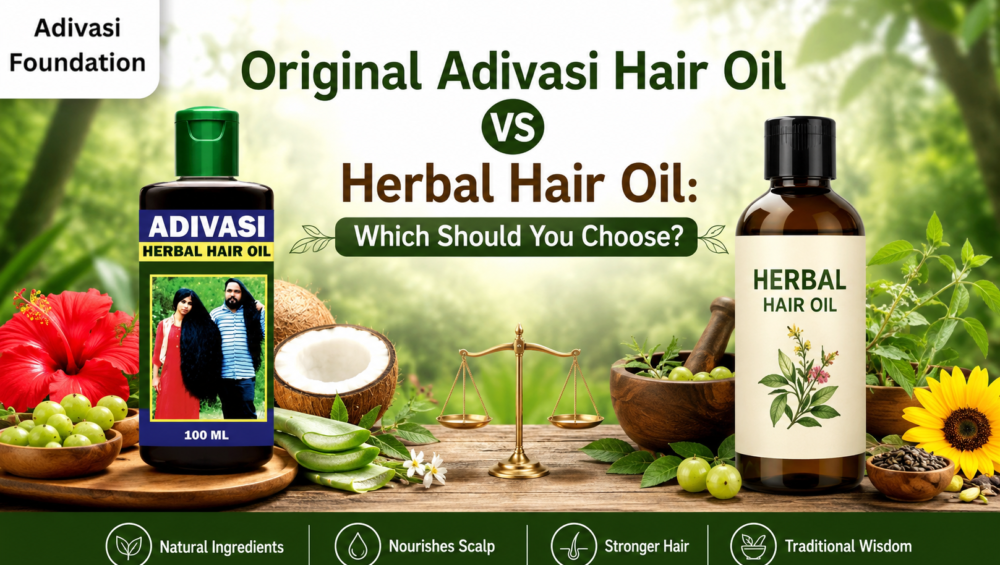
Original Adivasi Hair Oil vs Herbal Hair Oil: The Main Difference
The biggest distinction in Original Adivasi Hair Oil vs Herbal Hair Oil comes down to product identity and formulation philosophy.
Original Adivasi Hair Oil is generally positioned around traditional Adivasi-inspired hair-care practices and a combination of botanical ingredients. Herbal hair oil, meanwhile, is an umbrella term covering a large variety of plant-based hair oils.
In simple terms, an Adivasi-inspired oil may fall within the broader herbal hair-care category, but not every herbal hair oil is an Adivasi hair oil.
That distinction matters when comparing products.
Instead of asking whether Adivasi oil or herbal oil is universally better, consumers can ask a more useful question: Which formulation is more suitable for my scalp, hair characteristics, routine, and preferences?
Comparing the Ingredient Approach
Ingredients are among the most important factors when selecting any hair oil.
Traditional or herbal formulations may incorporate several plant-derived ingredients, but the presence of herbs alone does not automatically determine how suitable a product will be for every person.
Botanical Ingredients
Adivasi-inspired hair oils may combine different herbs and plant ingredients associated with traditional hair-care routines.
General herbal hair oils can also contain multiple botanicals. Popular ingredients across the category may include:
- Amla
- Bhringraj
- Hibiscus
- Fenugreek
- Neem
- Brahmi
- Aloe vera
- Curry leaves
- Coconut oil
- Sesame oil
- Almond oil
These are examples commonly encountered in traditional and herbal hair-care formulations; they should not be interpreted as the exact ingredient list of every Adivasi hair oil.
Always check the product label for its actual composition.
Carrier Oils
Herbal ingredients usually need an appropriate oil base. Coconut, sesame, almond, and similar oils are frequently used as carriers in traditional hair-care preparations.
The base oil can influence the product’s texture, absorption, fragrance, and how heavy it feels on the scalp.
Someone with very dry hair may prefer a richer formulation, while a person who dislikes greasy products might be more comfortable with a lighter oil.
Traditional Formulation vs General Herbal Formulation
Another useful way to examine Original Adivasi Hair Oil vs Herbal Hair Oil is through the philosophy behind the formulation.
Adivasi-inspired products emphasize their association with traditional tribal knowledge and botanical hair-care practices. This traditional identity is a major reason many consumers become interested in these products.
Conventional herbal hair oils can be formulated from many different traditions or modern cosmetic approaches. A manufacturer may develop a herbal oil around one primary ingredient or combine numerous extracts in a commercial formulation.
Neither approach automatically makes a product superior.
What matters is whether the ingredients, manufacturing quality, instructions, and formulation match what the consumer needs.
Which Option Is Better for Dry Hair?
Dry hair often needs additional conditioning and protection against moisture loss.
Hair oils can coat the strands, reduce the feeling of roughness, and make dry hair appear smoother. A formulation containing an appropriate carrier oil may therefore fit well into a dry-hair routine.
When comparing an Adivasi-inspired product with another herbal oil, look beyond the front label. Examine the base oils and the overall texture.
A lightweight formulation might not provide the feel someone with extremely dry hair wants. Conversely, a very heavy formula may be inconvenient for fine hair.
Experimenting with a small amount is often more practical than saturating the hair immediately.
What About Oily Scalps?
Having an oily scalp does not necessarily mean hair oil must be completely avoided, but the amount and frequency may need adjustment.
People whose scalps become greasy quickly may prefer smaller quantities and shorter application periods. Applying excessive oil can make the hair feel heavy and may require more shampooing to remove it.
In the Original Adivasi Hair Oil vs Herbal Hair Oil comparison, neither category can automatically be declared better for oily scalps.
Texture and formulation are more relevant.
Start with a limited amount and observe how the scalp and hair respond.
Choosing Hair Oil for Frizzy or Rough Hair
Frizz and rough texture are common reasons people incorporate oils into their routines.
Oil can help coat the hair shaft, improve manageability, and provide a smoother appearance. Applying a small amount to the lengths may also help reduce the dry feeling that often accompanies frizzy hair.
Both Adivasi-inspired oils and general herbal oils may work as conditioning products depending on their formulations.
People with coarse or thick hair may prefer richer oils, while those with fine hair often need considerably less product.
Scalp Massage and Hair-Care Routine
For many people, oiling is as much about the routine as the product.
Gentle scalp massage helps distribute oil across the scalp and can make hair care feel relaxing. There is no need to massage aggressively. Strong rubbing or scratching can irritate the scalp and place unnecessary stress on the hair.
A practical routine may involve dividing the hair into sections, applying small quantities of oil, gently massaging the scalp with fingertips, and distributing the remaining oil through the hair lengths when desired.
Follow the directions provided with the specific product regarding application time and washing.
Can Hair Oil Make Hair Grow Faster?
Consumers should be careful with claims suggesting that any cosmetic hair oil can guarantee rapid hair growth.
Hair growth is influenced by numerous factors, including genetics, nutrition, age, hormones, scalp health, hair-care practices, and certain medical conditions.
Hair oils can support a conditioning routine by moisturizing the scalp and hair, improving manageability, and helping reduce dryness-related roughness. These cosmetic benefits should not be confused with guaranteed treatment for hair loss or medically significant hair-growth problems.
If someone experiences sudden, severe, patchy, or persistent hair loss, professional medical evaluation is more appropriate than relying exclusively on cosmetic oils.
Does “Natural” Automatically Mean Better?
No.
Natural and herbal are popular descriptions in personal care, but they should not replace careful evaluation of a formulation.
Plant-derived ingredients can still cause irritation or allergic reactions in some individuals. A botanical ingredient that works well for one person’s scalp might not suit another.
Consumers should therefore pay attention to:
- The complete ingredient list
- Manufacturer information
- Usage instructions
- Product packaging
- Expiration or best-before information
- Individual allergies and sensitivities
- Scalp response after application
Performing a patch test before extensive use can be a sensible precaution, particularly for people with sensitive skin.
Authenticity Matters When Buying Adivasi Hair Oil
Growing interest in Adivasi hair oils means buyers may encounter many products using similar terminology.
Consumers looking specifically for Original Adivasi Hair Oil should pay attention to where the product comes from rather than relying on the name printed prominently on a marketplace listing.
Check packaging details, manufacturer or seller information, labeling, seals where applicable, and the ingredient list. Buying through a trusted source can reduce uncertainty about what you are actually receiving.
Adivasi Foundation encourages consumers to evaluate authenticity alongside formulation quality when selecting traditional hair-care products.
How Often Should You Apply Hair Oil?
There is no universal oiling schedule that works for everyone.
Hair texture, scalp oiliness, styling habits, climate, washing frequency, and product formulation can all affect how frequently oil feels beneficial.
Some people incorporate oil into their routine once or twice a week. Others use it less frequently, while people with very dry hair may prefer more regular conditioning.
The key is monitoring how the hair responds.
If hair repeatedly feels greasy, weighed down, or difficult to wash, reducing the amount or frequency may help. If the scalp becomes itchy, irritated, or uncomfortable after using a particular product, discontinue use and assess whether an ingredient may be causing sensitivity.
How to Compare Two Hair Oils Before Buying
Marketing descriptions can make different hair oils sound remarkably similar. The label provides more useful information.
Start by examining the ingredients.
Look at which carrier oils appear in the formulation and which botanical ingredients are included. Then consider whether those ingredients align with your intended use.
Next, assess the product’s authenticity and manufacturer information. Transparent labeling is especially important when purchasing a traditional or herbal formulation.
Finally, think realistically about your routine. A product can have an appealing ingredient list but still be inconvenient if its texture, fragrance, or application process does not suit your preferences.
Original Adivasi Hair Oil vs Herbal Hair Oil for Regular Use
For regular use, consistency and suitability matter more than choosing the category with the strongest marketing claims.
Original Adivasi Hair Oil may appeal particularly to people interested in traditional Adivasi-inspired botanical formulations. A conventional herbal hair oil may appeal to consumers who want a particular herb, carrier oil, texture, fragrance, or specialized cosmetic benefit.
Either can become part of a regular routine when the formulation suits the individual.
The decision should therefore be based on actual ingredients and personal hair requirements.
Common Mistakes When Choosing Hair Oil
One common mistake is assuming that more ingredients automatically mean a better product. A long botanical ingredient list does not guarantee that a formulation will suit your scalp.
Another mistake is using too much oil. Hair does not necessarily receive greater cosmetic benefits simply because it is saturated with product.
Consumers may also switch products too frequently. Constantly changing a routine makes it difficult to determine which product works comfortably for the hair and scalp.
Most importantly, avoid expecting cosmetic hair oils to solve every hair or scalp concern. Persistent dandruff, scalp inflammation, significant hair shedding, or unexplained hair loss may require professional attention.
How to Make the Right Choice
When considering Original Adivasi Hair Oil vs Herbal Hair Oil, focus on five practical factors: formulation, authenticity, hair type, scalp characteristics, and intended use.
Choose an Adivasi-inspired hair oil if you specifically value a traditional botanical formulation and want to incorporate that approach into your hair-care routine.
Choose another herbal hair oil if its specific ingredients, carrier oil, texture, or intended purpose better matches your preferences.
There is also no requirement to follow trends. Hair care is highly individual, and a product that receives positive attention may still not be appropriate for every scalp or hair type.
Why Consider Adivasi Foundation?
Adivasi Foundation focuses on traditional plant-based hair-care practices while recognizing the importance of informed product selection.
Consumers increasingly want to know what they are applying to their scalp, how a product fits into their routine, and what results they can realistically expect. Clear information helps separate practical hair care from exaggerated promises.
When choosing an Adivasi-inspired oil, consumers should prioritize authenticity, appropriate usage, and consistency. A traditional approach can complement a sensible hair-care routine when the selected product suits the individual’s needs.
Final Thoughts
The Original Adivasi Hair Oil vs Herbal Hair Oil comparison does not have a single winner for every person. Original Adivasi Hair Oil is associated with a more specific traditional Adivasi-inspired approach, while herbal hair oil represents a much broader category of botanical formulations.
Rather than choosing solely by product name, compare ingredients, carrier oils, authenticity, texture, and suitability for your scalp and hair. A carefully selected oil, used appropriately and consistently, can support softer, more manageable, healthier-looking hair without relying on unrealistic promises.
FAQs
Which is better in Original Adivasi Hair Oil vs Herbal Hair Oil?
Neither category is universally better. The more suitable choice depends on the ingredient list, base oils, hair texture, scalp characteristics, product authenticity, and your personal hair-care goals.
Can Original Adivasi Hair Oil be used regularly?
It can be incorporated into a regular hair-care routine when used according to the product's instructions and when the formulation suits the individual's scalp and hair. Frequency can be adjusted according to oiliness, dryness, washing habits, and personal preference.
How can I choose between Original Adivasi Hair Oil and another herbal oil?
Compare the ingredients, carrier oils, manufacturer information, authenticity, application instructions, and intended cosmetic benefits. Choose a formulation that matches your hair type and scalp needs rather than relying only on labels or promotional claims.