
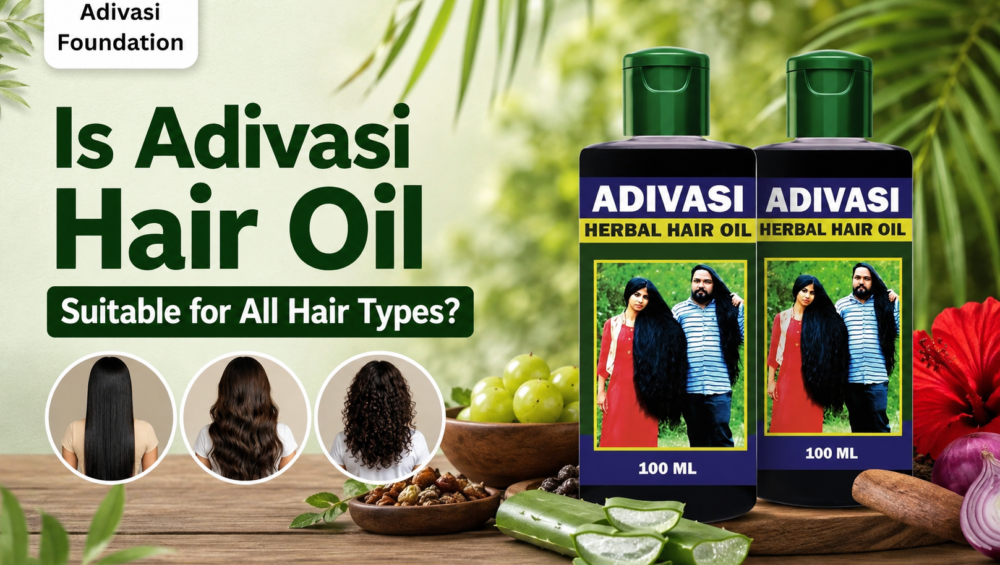
Hair care rarely follows a one-size-fits-all approach. Straight, curly, wavy, dry, oily, fine, thick, chemically treated, and textured hair can each respond differently to oils and herbal preparations. Adivasi Hair Oil is commonly associated with a blend of traditional herbs and plant-based ingredients used as part of regular scalp and hair care routines. However, people considering herbal hair oil often want to know whether the same formulation can work effectively across different hair types.
The answer depends on several factors, including hair texture, scalp condition, porosity, oil quantity, application method, and washing routine. Choosing the right approach can make oiling more comfortable and suitable for individual hair needs.
Why Hair Type Matters When Choosing a Hair Oil
Hair type affects how quickly oil spreads, how much product the strands can tolerate, and how easily the oil washes out. Someone with fine, straight hair may find a large quantity of oil heavy, while thick or curly hair may need more product to coat the lengths evenly.
Scalp characteristics matter just as much. A person can have dry hair with an oily scalp or fine hair with a dry scalp. For this reason, evaluating both the scalp and hair strands provides a better basis for deciding how to use an herbal oil.
Important factors include:
- Hair strand thickness
- Natural oil production
- Scalp dryness or oiliness
- Hair density
- Curl pattern
- Hair porosity
- Chemical treatments
- Heat styling frequency
- Washing habits
- Environmental exposure
Rather than applying the same amount to every hair type, users can adjust the quantity and frequency according to their individual requirements.
Is Adivasi Hair Oil Suitable for Straight Hair?
Straight hair allows natural scalp oils to travel down the hair shaft relatively easily. As a result, some people with straight hair experience oiliness around the roots sooner than people with curly or highly textured hair.
Herbal hair oil can still form part of a straight-hair routine when applied in an appropriate quantity.
For Fine, Straight Hair
Fine strands can become weighed down quickly. Using too much oil may make the hair appear flat or greasy, even after washing.
A small amount applied primarily to the scalp may be more suitable. If the ends feel dry, a very light coating can be applied separately.
People with fine hair may prefer shorter pre-wash oiling sessions instead of leaving a heavy layer on the hair for extended periods.
For Thick, Straight Hair
Thicker strands generally tolerate oil more easily. The oil can be distributed from the scalp through the mid-lengths, with additional attention given to dry ends.
However, the quantity should still depend on hair density and scalp condition rather than thickness alone.
Can Adivasi Hair Oil Be Used on Wavy Hair?
Wavy hair sits between straight and curly textures and can have very different characteristics from one person to another. Some wavy hair becomes oily quickly at the roots while remaining dry at the ends.
This combination calls for balanced application.
Applying a moderate quantity to the scalp and a smaller amount to the lengths can help avoid unnecessary heaviness. People who want to preserve natural wave definition may also prefer to oil before shampooing rather than applying substantial amounts after washing.
The washing method matters as well. Residual oil can make waves appear less defined, so proper cleansing after an oiling session is important.
How Does Adivasi Hair Oil Fit into Curly Hair Care?
Curly hair often experiences greater dryness because natural scalp oils have a more difficult path down curved hair strands. Consequently, oiling can be particularly appealing to people with curls.
A herbal oil can be applied to the scalp as well as the lengths, depending on individual needs.
Applying Oil to Curly Hair
Divide the hair into manageable sections before application. Sectioning helps distribute oil more evenly without repeatedly pulling or manipulating the curls.
Start with the scalp and gently massage using the fingertips. Then spread a smaller amount along the lengths, paying particular attention to dry areas and ends.
Avoid aggressive rubbing because friction can encourage tangling and disrupt the curl pattern.
Finding the Right Quantity
Curly hair does not automatically require a large quantity of oil. Curl density, strand thickness, and porosity should influence the amount.
Fine curls may respond better to lighter application, while thick and dense curls may tolerate a little more.
What About Coily and Highly Textured Hair?
Coily and highly textured hair tends to experience dryness more easily because of its tightly curved structure. The ends can be especially vulnerable to moisture loss and mechanical stress.
Oiling can serve as one component of a broader hair care routine for this texture.
Users may apply oil carefully across the scalp and sections of the hair. Particular attention can be given to the ends, which are the oldest part of the hair shaft.
However, oil should not replace hydration. Oils primarily coat and lubricate hair; they do not provide water-based hydration. A balanced routine may therefore combine suitable cleansing, conditioning, hydration, and oiling.
Can People with Dry Hair Use Adivasi Hair Oil?
Dry hair often feels rough, lacks flexibility, and may become tangled easily. Environmental exposure, frequent shampooing, heat styling, chemical processing, or naturally low sebum production can contribute to dryness.
A pre-shampoo oiling routine can help reduce friction during washing and provide lubrication to dry strands.
For dry hair, users may consider applying oil to both the scalp and lengths. The ends often deserve additional attention because they are more exposed to daily wear.
The frequency should still depend on how the hair responds. More frequent application is not automatically better.
Is It Appropriate for Oily Hair?
Having an oily scalp does not necessarily mean someone must avoid hair oil entirely. It does, however, mean that application should be controlled.
An oily scalp already produces substantial sebum. Adding excessive oil can create a heavy feeling and may require stronger or repeated cleansing.
For oily hair:
- Use a smaller quantity.
- Avoid saturating the scalp.
- Consider shorter oiling periods.
- Wash thoroughly after application.
- Adjust frequency according to scalp response.
People with very oily scalps may prefer occasional rather than frequent application.
Can It Be Used on Fine Hair?
Fine hair has a smaller strand diameter and can lose volume easily when coated with heavy products. The key consideration is quantity.
Instead of soaking the entire head, apply a small amount in sections. Gentle scalp massage can distribute the product without requiring excessive oil.
Fine-haired users can also avoid repeatedly coating the lengths unless they experience noticeable dryness.
If the hair continues to feel greasy after shampooing, reducing the amount used during the next application may provide a better balance.
What About Thick and Dense Hair?
Thick or highly dense hair can make even distribution challenging. Applying oil only to the surface may leave several areas untouched.
Sectioning is especially useful for dense hair.
Divide the hair into four or more sections and apply a controlled amount directly to the scalp within each section. The remaining oil can then be distributed along the lengths.
This approach provides better control than pouring or applying a large quantity at once.
Hair Porosity Can Influence the Results
Hair type is not determined by curl pattern alone. Porosity—the hair’s ability to absorb and retain moisture—can influence how products behave.
Low-Porosity Hair
Low-porosity hair has tightly arranged cuticle layers. Products may sit on the surface rather than spreading or absorbing easily.
Heavy oil application can therefore leave low-porosity hair feeling coated.
Smaller quantities and shorter application periods may be more appropriate.
Medium-Porosity Hair
Medium-porosity hair often responds predictably to different hair products. A moderate oiling routine may work well, provided the scalp and strands remain comfortable.
High-Porosity Hair
High-porosity hair can lose moisture quickly and may feel rough or dry. Chemical processing, heat exposure, and physical damage can also increase porosity.
Oil can help lubricate the strands and reduce friction, but it should remain part of a routine that includes appropriate conditioning and moisture care.
Is Adivasi Hair Oil Suitable for Chemically Treated Hair?
Colouring, bleaching, rebonding, perming, relaxing, and other chemical processes can alter the structure and condition of hair.
Chemically treated hair often requires gentle handling because it may become more porous or prone to breakage.
An oiling routine can provide lubrication before washing, but users should consider the instructions associated with their specific chemical treatment. Immediately after certain salon procedures, stylists may recommend avoiding particular products or washing methods for a defined period.
Once regular hair care resumes, moderate oil application can be adjusted according to the condition of the scalp and strands.
Can It Be Used on Heat-Styled Hair?
Frequent use of straighteners, curling irons, blow dryers, and other heated tools can contribute to dryness and structural damage, particularly when high temperatures are used repeatedly.
Pre-wash oiling may complement a routine designed for frequently styled hair. However, hair oil should not automatically be treated as a heat protectant.
A product specifically formulated for heat protection should be used before high-temperature styling when required.
Reducing excessive heat exposure and maintaining appropriate conditioning are equally important for preserving hair quality.
Scalp Type Is Just as Important as Hair Type
Many people select hair products based solely on whether their hair is curly, straight, thick, or fine. Scalp condition deserves equal consideration.
Dry Scalp
A dry scalp may feel tight or uncomfortable and can sometimes show visible flaking. A modest amount of oil may provide temporary lubrication, but persistent scalp problems should not automatically be treated with cosmetic oil alone.
Oily Scalp
People with oily scalps should use smaller quantities and pay attention to how quickly buildup develops.
Sensitive Scalp
Anyone with sensitive skin should be cautious when trying a new herbal formulation. Natural ingredients can still cause irritation or allergic reactions in some individuals.
Performing a patch test before broader application is a sensible precaution.
How to Perform a Patch Test
A patch test is particularly useful when using a new cosmetic or herbal product.
Apply a small amount to a limited area of skin according to the product’s directions and observe the area for signs of irritation. If redness, itching, swelling, burning, or other unusual reactions occur, discontinue use.
Ingredient labels should also be reviewed carefully, especially by people with known allergies or sensitivities.
“Herbal” and “natural” do not mean that every ingredient is suitable for every individual.
How Much Hair Oil Should You Apply?
There is no universal quantity that works for everyone. Hair length, density, texture, scalp type, and personal preference all influence the appropriate amount.
The goal does not have to be complete saturation.
Start with a modest quantity and add more only when necessary. This method makes application easier and can also simplify shampooing.
Excessive oil may require repeated cleansing, which can leave some hair types feeling dry.
A Practical Application Method for Different Hair Types
A controlled technique can make hair oil easier to incorporate into a routine.
First, gently detangle the hair if necessary. Divide dense or curly hair into sections. Apply a modest amount of oil to different areas of the scalp rather than concentrating it in one spot.
Massage gently with the fingertips without scratching the scalp. If the lengths need additional care, spread a small quantity between the palms and apply it gradually from the mid-lengths toward the ends.
Leave the oil on according to the product directions and personal tolerance. Afterwards, cleanse thoroughly with a suitable shampoo.
How Often Should You Oil Your Hair?
Frequency depends more on individual response than on a fixed schedule.
Someone with a dry scalp and thick hair may prefer oiling more regularly, whereas a person with fine hair and an oily scalp may use it less often.
Observe factors such as:
- How quickly the scalp becomes greasy
- Whether the hair feels weighed down
- Ease of shampooing
- Dryness between washes
- Scalp comfort
- Product buildup
Adjusting the routine based on these signs is more practical than following an identical schedule for every hair type.
Common Mistakes to Avoid When Using Hair Oil
Even a suitable product can produce an unpleasant experience when applied incorrectly.
One common mistake is using far more oil than the hair requires. More product does not necessarily produce better results.
Another issue is aggressive scalp massage. Strong rubbing, scratching, or pulling can irritate the scalp and place unnecessary stress on the hair.
Users should also avoid assuming that oil can replace shampoo, conditioner, or medical treatment. Each serves a different purpose.
Leaving heavy oil buildup on the scalp repeatedly without adequate cleansing can also create discomfort for some people.
What Results Should Users Realistically Expect?
Hair oil is primarily a cosmetic hair and scalp care product. Depending on its formulation, it can help lubricate strands, support smoother handling, and complement a regular grooming routine.
Individual results vary because hair condition is influenced by genetics, grooming habits, chemical treatments, nutrition, environmental exposure, scalp health, and many other factors.
Consumers should be cautious about expecting instant or guaranteed transformations from any cosmetic hair oil.
A consistent and suitable overall routine generally matters more than relying on a single product.
Choosing Authentic Hair Care Products Matters
Interest in traditional and herbal hair care has led to many similarly named products appearing across different sales channels. Consumers should examine product information carefully before purchasing.
Look for clear labeling, ingredient details, usage directions, manufacturer information, and appropriate packaging. Avoid making decisions solely on dramatic promotional claims.
Adivasi Foundation encourages consumers to approach traditional hair care with realistic expectations and attention to individual hair and scalp needs. Product suitability should always take priority over following a trend or copying another person’s routine.
So, Is Adivasi Hair Oil Suitable for Every Hair Type?
Adivasi Hair Oil can potentially fit into routines for straight, wavy, curly, coily, fine, thick, dry, and chemically treated hair, but the method of use should vary.
Fine or oily hair generally benefits from lighter application. Dry, curly, thick, or highly textured hair may tolerate more oil, particularly on the lengths and ends. Low-porosity hair may require less product, while high-porosity hair may benefit from oil as part of a broader moisture-focused routine.
Most importantly, scalp sensitivity, allergies, product ingredients, and individual response should always be considered.
Conclusion
Different hair types have different requirements, which makes personalized application essential. Adivasi Hair Oil can be incorporated into many hair care routines when users adjust the quantity, frequency, and application technique to suit their scalp and strands. Fine and oily hair may need lighter use, while dry, curly, or dense hair may tolerate more. Checking ingredients, performing a patch test, following product directions, and observing how the hair responds can help users build a more suitable oiling routine.
FAQs
Can people with oily scalps use Adivasi Hair Oil?
People with oily scalps can consider using it in smaller quantities and for shorter periods before shampooing. Excessive application may contribute to a greasy feeling or buildup. Users should adjust frequency according to their scalp response and cleanse thoroughly after use.
Can Adivasi Hair Oil be applied to curly hair?
Yes, oil can form part of a curly hair routine. Sectioning the hair before application can make distribution easier. Curly hair that tends to become dry may benefit from careful application along the lengths and ends, while fine curls may require a lighter quantity.
How often should Adivasi Hair Oil be used?
There is no single frequency suitable for everyone. Hair texture, scalp oil production, washing schedule, density, and product buildup all influence how often oiling feels appropriate. Starting conservatively and adjusting the routine according to the hair and scalp response is a practical approach.