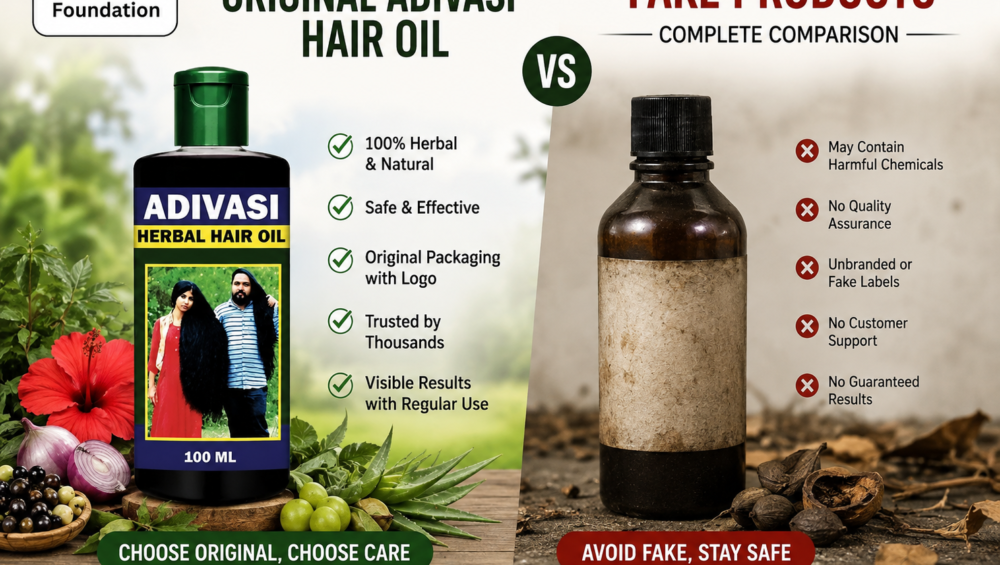
original Adivasi hair oil with fake productsCategoriesBlog

Original Adivasi Hair Oil vs Fake Products: Complete Comparison

Adivasi hair oil has attracted significant interest among people looking for traditional, herbal approaches to everyday hair care. As demand increases, buyers may also encounter products with similar names, packaging, claims, or visual identities. This can make it difficult to determine whether a product comes from a credible source.

Knowing the differences between Original Adivasi Hair Oil vs Fake Products can help buyers make more informed purchasing decisions. Packaging quality, ingredient information, seller credibility, pricing, labelling, contact details, and product consistency can all provide useful clues before purchase or use.

Why Authenticity Matters When Buying Adivasi Hair Oil

Hair oil comes into direct contact with the scalp and hair, so product authenticity should matter as much as price or popularity. Buyers should know what they are applying, who supplied it, what information appears on the label, and whether the seller provides sufficient product details.

An authentic product should provide clear information that allows consumers to identify its source and make a reasoned purchase. Suspicious products may imitate visual elements or use familiar terminology while providing limited information about their origin.

Buying questionable hair oil may create several concerns. The product may contain different ingredients from those expected, follow inconsistent manufacturing practices, or provide insufficient instructions for safe use.

Authenticity therefore involves more than recognising a bottle. Buyers should evaluate the entire purchase journey, from the seller and product listing to packaging, labelling, delivery, and the condition of the oil itself.

Original Adivasi Hair Oil vs Fake Products: Key Differences

The safest way to compare products is to examine several factors together rather than relying on a single feature. Counterfeit or imitation products can sometimes reproduce colours, fonts, bottle shapes, and other visible characteristics.

1. Packaging Quality

Packaging often provides the first opportunity to inspect a product.

A genuine product should normally arrive in packaging that appears professionally prepared and consistent with the seller’s current product presentation. Buyers can examine the bottle, cap, seal, label placement, print clarity, spelling, and overall finish.

Warning signs can include:

  • Blurry or poorly printed labels
  • Spelling and grammatical errors
  • Uneven label placement
  • Damaged or suspicious seals
  • Low-quality printing
  • Missing product information
  • Unclear manufacturer or marketer details
  • Packaging that differs substantially from official product images

Packaging alone cannot prove authenticity because packaging designs may change. It should form one part of a broader verification process.

2. Ingredient Information

Consumers increasingly want to know what goes into their personal care products. Ingredient information therefore plays an important role when comparing hair oils.

Traditional Adivasi-inspired hair oils may contain combinations of herbs, botanical extracts, plant-based oils, or other hair-care ingredients. However, consumers should avoid assuming that every product carrying the term “Adivasi” uses the same formulation.

Read the label carefully.

Check whether the product provides meaningful ingredient information and whether the seller gives consistent details across its product page, packaging, and promotional materials.

A suspicious product may use vague phrases such as “100% herbal” without giving enough information for buyers to assess what the product actually contains.

Consumers with known sensitivities should pay particular attention to ingredients and stop using a cosmetic product if irritation or an unexpected reaction occurs.

3. Seller Credibility

The seller can provide one of the strongest clues about authenticity.

Consumers should preferably purchase through an official or clearly authorised sales channel when available. Buying from an unknown seller solely because the product costs less can increase the risk of receiving an imitation, old stock, improperly stored item, or unrelated product.

Before placing an order, check:

  • Seller identity
  • Contact information
  • Product description
  • Return or replacement terms
  • Payment options
  • Customer support availability
  • Product photographs
  • Order confirmation process
  • Shipping information

A seller that provides transparent information gives consumers more opportunities to verify what they are purchasing.

Adivasi Foundation customers should use the organisation’s recognised purchasing and communication channels when seeking its products rather than relying on unrelated listings using similar terminology.

4. Product Price

Price can attract attention, but it should never serve as the only authenticity test.

If one seller offers a hair oil at a dramatically lower price than recognised sources, buyers should investigate why. Extremely low prices can sometimes indicate imitation products, unauthorised stock, altered products, or misleading listings.

However, a higher price does not automatically mean a product is genuine.

Discounts, promotional offers, quantity differences, shipping charges, bottle sizes, and sales campaigns can legitimately affect pricing. Compare like-for-like products and examine the seller before making conclusions based on cost.

The better question is whether the price makes sense when considered alongside the product size, seller, packaging, source, and available product information.

5. Label Information

A product label should help consumers identify what they have purchased.

Look closely at the information printed on the bottle and outer packaging, where applicable. Depending on the product category and applicable requirements, relevant information may include product identity, quantity, batch details, dates, manufacturer or marketer information, directions, warnings, and customer care details.

Missing, unreadable, altered, or contradictory information should encourage closer inspection.

Consumers should also compare label details with information provided through the recognised seller channel. Significant unexplained differences deserve attention.

Do not judge authenticity simply because a label uses familiar colours or traditional imagery. Visual imitation can be easier than reproducing consistent product information.

6. Seal and Bottle Condition

Inspect the product immediately after delivery.

The cap should appear secure, and any applicable protective seal should not show obvious signs of interference. Leakage, broken caps, damaged packaging, loose seals, or evidence that the container has previously been opened should be taken seriously.

Take photographs before opening a suspicious package. These images can help when contacting the seller about replacement, return, or verification.

Consumers should avoid using a product if they reasonably suspect tampering.

Bottle condition also matters because improper transportation or storage can affect a genuine product. Damage does not necessarily prove counterfeiting, but it gives buyers a valid reason to contact the seller before use.

7. Colour, Texture, and Aroma

Consumers sometimes attempt to identify genuine herbal hair oil entirely by colour or smell. This method has limitations.

Plant-derived ingredients can show natural variations. Colour, thickness, sediment, and aroma may vary depending on formulation, raw materials, processing, storage, or production batch.

A fake product might also imitate the expected colour and fragrance.

Therefore, sensory characteristics should support other evidence rather than replace it.

If a previously purchased product suddenly appears substantially different, compare the packaging, batch information, seller source, and ingredient information. Contact the recognised seller or customer support channel when the difference seems unusual.

Do not taste or intentionally expose yourself to a product simply to test whether it is genuine.

8. Product Claims

Exaggerated promises deserve careful attention.

Hair and scalp products should not be selected merely because an advertisement promises extraordinary results within an unusually short period. Claims such as guaranteed hair growth, permanent solutions, or identical results for every user should encourage consumers to examine the product more carefully.

Hair appearance and condition can vary significantly between individuals because of genetics, grooming practices, diet, age, environment, chemical treatments, scalp condition, and numerous other factors.

Authenticity and effectiveness are also different questions.

A product can be genuine without producing the same outcome for every consumer. Similarly, convincing marketing language cannot prove that a product is authentic.

Buyers should favour transparent product information over dramatic promises.

9. Online Product Listings

Online shopping makes hair-care products accessible, but it can also make imitation easier to distribute.

Before purchasing, inspect the entire listing rather than looking only at the main photograph.

Check whether the seller clearly identifies the product, bottle quantity, price, delivery conditions, return terms, and source. Look for inconsistencies between photographs and written descriptions.

Copied images deserve particular attention. An unknown seller may use photographs taken from another source without actually supplying the pictured product.

Customer reviews can provide additional information, but reviews should not act as the sole verification method. Reviews may relate to different batches, sellers, product sizes, or customer expectations.

Verify the seller first.

10. Batch and Product Details

Batch-related information helps with product identification and traceability.

When such information appears on a product, it should be clearly printed and readable rather than appearing carelessly altered or obscured.

If buyers have doubts, they can provide the available batch and purchase information when contacting the seller. Keep the invoice, order confirmation, delivery label, and photographs until you feel confident about the product.

These records become particularly useful when reporting a suspected counterfeit.

Never assume that the presence of a batch number alone proves authenticity. Sophisticated imitation products may reproduce numbers and other visible details. Verification should involve multiple indicators.

Common Signs That a Hair Oil May Be Fake

No single sign conclusively proves that a hair oil is counterfeit. Several warning signs appearing together, however, should encourage consumers to investigate before using the product.

Possible warning signs include poor print quality, missing information, suspiciously low pricing, unknown seller identity, inconsistent bottle design, damaged seals, unusual spelling errors, unexplained formulation differences, misleading product claims, or lack of customer support information.

Another warning sign involves sellers deliberately creating urgency to prevent buyers from checking details. Consumers should have enough information to assess a product before payment.

When uncertain, avoid opening or using the product until you have contacted the recognised source.

Why Fake Hair Oil Can Create Consumer Risks

Counterfeit personal-care products create concerns because buyers cannot confidently determine what the bottle contains or how it was produced, stored, or handled.

A questionable oil might contain undeclared substances or ingredients in unexpected concentrations. Poor manufacturing or storage conditions may also affect product quality.

Consumers should treat scalp irritation, burning, redness, swelling, or other unexpected reactions seriously. Stop using the product and seek appropriate medical advice when necessary.

Counterfeiting can also create financial loss. A customer may pay for a product believing it comes from a particular source while receiving something entirely different.

This makes authenticity verification both a product-quality issue and a consumer-protection issue.

How to Check Adivasi Hair Oil Before Buying

A practical verification process begins before payment.

First, identify the recognised source for the product you want. Compare the product description, quantity, packaging presentation, and seller information with that source.

Second, evaluate the price. A substantial unexplained difference should trigger additional checks.

Third, examine available photographs carefully. Look at the front label, back label, cap, container, and packaging rather than relying on a promotional image.

Fourth, review delivery and return conditions. Consumers should know what options exist if they receive a damaged, incorrect, or suspicious product.

Finally, retain proof of purchase. An invoice or order record can help establish where and when you bought the item.

What to Check After Receiving Your Order

Do not throw away the packaging immediately.

Compare the delivered item with the product you ordered. Confirm the bottle size, label, seal, seller information, and available batch or date details.

Check for leakage or signs of tampering.

If something looks suspicious, photograph the bottle from several angles before opening it. Include close photographs of the label, cap, batch information, and shipping package.

Contact customer support through a recognised communication channel and provide the relevant order information.

Avoid applying a suspicious product merely to determine whether it “feels genuine.” Visual and documentary verification should come first.

Authentic Product Does Not Mean Identical Results

One of the most important points in hair care is that authenticity does not guarantee a particular cosmetic result.

People have different hair types, scalp characteristics, routines, environmental exposure, and grooming habits. The same oil may therefore feel different on two individuals.

Some users prefer frequent oiling, while others use smaller quantities less often. Hair texture can also affect how quickly an oil spreads or how heavy it feels.

Consumers should follow appropriate product directions rather than increasing the quantity simply because they expect faster results.

Hair oil should form part of sensible hair care rather than replace professional assessment of persistent scalp or hair concerns.

How to Store Hair Oil Properly

Authentic products can deteriorate when stored incorrectly.

Follow storage instructions provided with the product. In general, consumers should keep hair oil securely closed and protect it from conditions that could adversely affect its quality.

Avoid transferring the oil into an unidentified container because doing so removes important product information and makes future verification difficult.

Keep the bottle clean and close the cap properly after every use.

Also monitor the product for significant unexpected changes during storage. If its smell, appearance, or consistency changes substantially and the product seems unsuitable for use, contact the seller for clarification.

Proper storage protects both product quality and traceability.

Consumer Awareness Is the Best Defence

Counterfeiters often depend on quick purchasing decisions. Consumers can reduce their risk by slowing down and checking the seller, packaging, label, pricing, and product information before ordering.

Do not assume every product using “Adivasi” terminology has the same origin or formulation.

Similarly, do not rely on one visual characteristic to establish authenticity.

The strongest approach combines seller verification with careful inspection of the delivered product. Consumers should also retain invoices and order records, particularly when purchasing personal-care products online.

Adivasi Foundation encourages buyers seeking its products to verify the source and product information rather than making decisions solely from advertisements or unusually low prices.

Final Thoughts

Comparing original and fake Adivasi hair oil requires more than checking the colour of the bottle or smelling the oil. Buyers should assess the seller, packaging, label information, seals, pricing, ingredient details, product claims, and purchase records together.

When a product raises doubts, consumers should verify it before use rather than relying on assumptions. Purchasing through recognised channels and keeping proof of purchase can further reduce unnecessary risk.

Careful verification helps consumers protect their money, avoid questionable products, and make more informed decisions when selecting Adivasi hair oil.

FAQs

Start by verifying the seller and comparing the listing with information available from the recognised product source. Check packaging photographs, quantity, label details, pricing, return conditions, and contact information. Be cautious when an unknown seller offers unusually low prices or provides incomplete product information.

Not reliably. Herbal formulations can show variations in colour, aroma, texture, or sediment because of ingredients, batches, storage, and processing. Counterfeit products may also imitate these characteristics. Seller verification, packaging, labels, seals, purchase records, and product details provide a stronger basis for assessing authenticity.

Avoid using the product until you verify it. Photograph the bottle, packaging, seal, label, and available batch information. Keep your invoice and order confirmation, then contact the recognised seller or customer support channel. If you experience an unexpected physical reaction after using any cosmetic product, seek appropriate medical advice.